

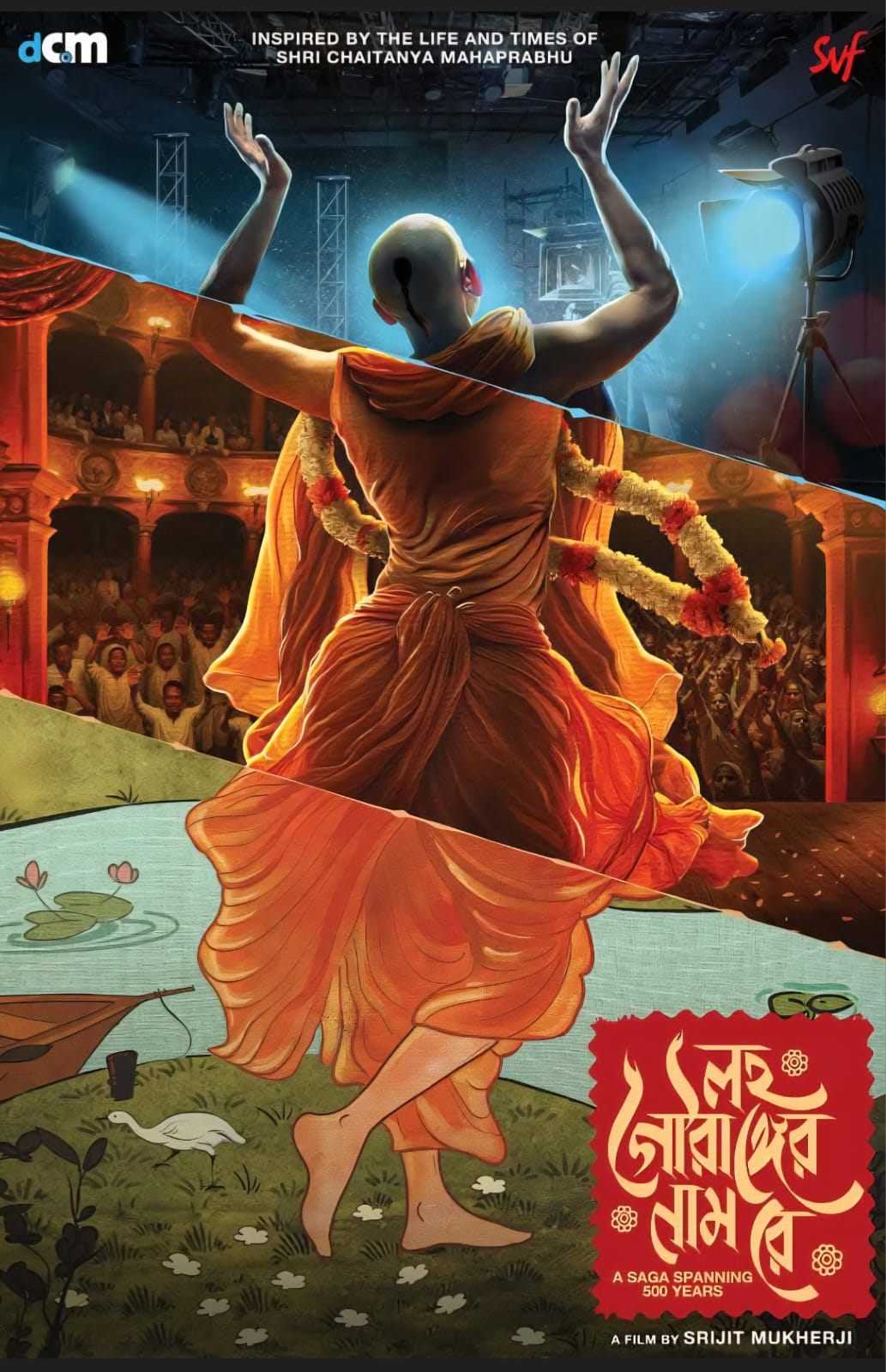
Srijit Mukherjee is surely intrigued by famous disappearances in Bengal's history. Hence, after Bhawal Sanyasi ('Ek Je Chhilo Raja', 2018) & Netaji ('Gumnaami', 2019), he has now directed his attention to Chaitanya Mahaprabhu. Exactly what happened to him: did he merge with the idols at Jagannath temple, did he vanish into the sea in Puri, or was he murdered by powerful opponents? The narrative of 'Lawho Gouranger Naam Re' investigates this through three parallel timeliness -- Chaitanya's own life (with debutante Dibyojyoti in the titular tole), as it was lived out between his first marriage & disappearance in the early 16th century, visually demarcated in the film by using a dreamy/misty filter; Nati Binodini (Subhashree) playing his character on stage in late 19th century Calcutta, directed by Natyacharya Girish Chandra Ghosh (Bratya Basu); and a contemporary filmmaker (Isha Saha) making a movie on him (with Indraneil Sengupta in the lead).
Like 'Jaatishwar' (2014) - which had two timelines, Antony Firingee's lifetime & the singer who researches his music in post-millennial years - the animating principle of the narrative is love: only, here it is the love of the divine instead of a mortal woman. And the actor who did become the character in expressing that love is Subhashree. As Binodini playing the medieval saint, she is more Chaitanya than Chaitanya himself, especially while performing the song, "Dyakho Dyakho Kanaiyye". Sung by Jayati Chakraborty, it's the very soul of the film. The other notable number is 'Shey Chole Geleo', by Kabir Suman.
A lot happens in all the three timelines of the narrative, with parallels in the loves & betrayals in the personal lives of the actor-directors in the second & third. (This aspect is strongly reminiscent of Kaushik Ganguly's 'Arekti Premer Golpo', 2010, with Chapal Bhaduri's life as the subject of the film within the film). The best part of 'Lawho...' is, however, when the theatre & the film intercut each other; with the actor-director duo in one timeline answering the questions that the other poses, and vice-versa -- discussing & arguing at an invisible table, as it were, across a century.
The theatre part is the strongest in the film -- both script & performance-wise. Binodini & Girish stood out for me, throughout; the scene where she confronts him, at the end, for S. She, in fact, seemed more affected by Binodini's life than Mahaprabhu's!
Her late dida was besotted with Basanta Chowdhury as Chaitanya (in the biopic by Debaki Bose), she'd confessed to me once. That was way back in the 1950s.
70 years on, Sri Chaitanya's celluloid journey continues...