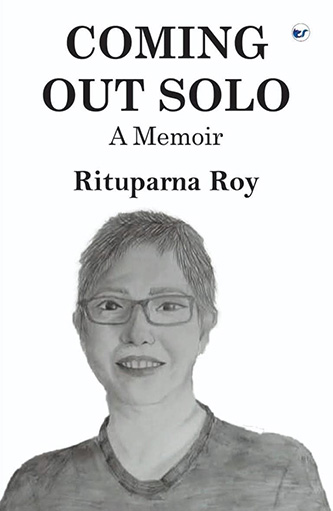
'COMING OUT SOLO: A Memoir' is Roy’s first work of non-fiction. It is about her owning up to her single status, haltingly, over half a decade; and coming to a point where she could finally accept and embrace being solo: of having an individual identity beyond marriage, without the express hope of new companionship in the future. It is a journey, she feels, that would resonate with many.
In 2017, when she returned to Kolkata after a decade of living and working in the Netherlands, it was not just a relocating back to a hometown for her, but the beginning of a radical new phase in her life: returning home with a small child to live with her recently widowed father, leaving behind a marriage of eighteen years. It also meant starting over in her career from scratch, at 43. Her octogenarian father was devastated, but he stood by her.
For the next five years, she would slowly grow into her new skin as a single mother – her new identity never denied but never quite acknowledged either – and eventually ‘come out’ solo after her divorce, owning up to a status that is still judged upon in Indian society. It is a blog she wrote (‘Kolkata Diaries’, KD) during this long transition that helped her evolve in this path; the blog posts themselves changing from a quotidian archiving of her renewed relationship with her city and natal home - with her past ever present and lives that impinged on hers - to a Covid chronicle during the pandemic years, and then morphing into personal essays of a moral reckoning with her ‘self’ and society.
Looking back, she finds KD can be divided into three distinct phases: the first year - end 2018 to 2019; the pandemic years - 2020 and 2021; and the year life returned to normalcy - 2022. These three phases – titled ‘Coming Back Home’, ‘Coping with Covid’ and ‘Coming Out Solo’ – constitute the three main sections of her memoir.
In conversation with Amrita Mukherjee, at the Kolkata Centre for Creativity (KCC), as part of their 'Library Talks' Series. 5 March 2025.
This book focuses on the aftermath of the 1947 Partition of India. It considers the long aftermath and afterlives of Partition afresh, from a wide and inclusive range of perspectives and studies the specificities of the history of violence and migration and their memories in the Bengal region. The chapters in the volume range from the administrative consequences of partition to public policies on refugee settlement, life stories of refugees in camps and colonies, and literary and celluloid representations of Partition. It also probes questions of memory, identity, and the memorialization of events.
Eclectic in its theoretical orientation and methodology, this book will be of interest to scholars and researchers of partition history, colonialism, refugee studies, Indian history, South Asian history, migration studies, and modern history in general.
The Long History of Partition in Bengal | Alipore Jail Museum, Kolkata | 16th August 2024.
My maiden collection of shorts, Gariahat Junction, was published in 2020 by Kitaab International Singapore.
It is a collection of nine short stories, of contemporary Indian women who have reached a critical juncture in their lives. Set primarily in post liberalized, post-millennial Kolkata, it mostly explores the lives of middle-class Bengali women in or from the city.
Indian English Fiction 2000-2010 (2013) - ISBN: 9789089645333
An assessment of twenty-first-century Indian-English fiction, Writing India Anew features fifteen essays by some of the most prominent scholars in the field and explores a range of themes, including the remapping of mythology and history, the reassessment of globalized India, and technical experimentation in the epic, science fiction, and the graphic novel.
Ultimately, the contributors to this volume contend that the current body of work in Indian-English fiction is so varied and vibrant that it can no longer be dismissed as derivative or dispossessed, or even as mere postcolonial “writing back” or compensatory national allegory.
With Prof. Krishna Sen – my former teacher and co-editor of Writing India Anew – at the joint AAS/ ICAS Conference held in Honolulu, Hawai’i, on 1 April 2011. WIA grew out of a panel I had organized there.
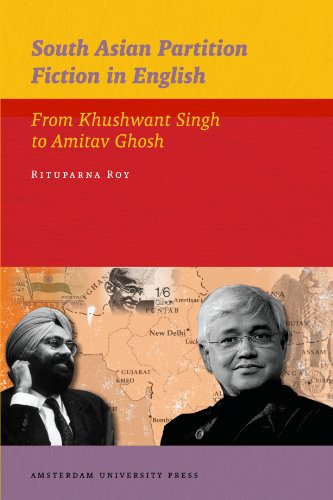
From Khushwant Singh to Amitav Ghosh (2010) - ISBN: 978 90 8964 245 5
South Asian Partition Fiction in English: From Khushwant Singh to Amitav Ghosh explores a significant cross-section of South Asian fiction in English written on the theme of Partition from the mid-1950s to the late 1980s, and shows how the Partition novel in English traverses a very interesting trajectory during this period – from just ‘reporting’ the cataclysmic event to theorizing about it.
The six novels selected for study (Train to Pakistan, A Bend in the Ganges, Ice-Candy-Man, Clear Light of Day, Midnight’s Children, and The Shadow Lines) show that, essentially, three factors shape the contours and determine the thrust of the narratives – the time in which the novelists are writing; the value they attach to women as subjects of this traumatic history; and the way they perceive the concept of the nation.
“Roy’s knowledge of the field of her investigation is comprehensive and detailed, and her textual analysis is lucid and penetrating.”
Review by Shirley Chew, Professor Emerita, University of Leeds In English Studies, 94 (2), 2013, pp. 247-248.
Second BOOK RELEASE in Kolkata, 3 January 2011. This event was held at the historic Jorasanko Thakurbari campus of Rabindra Bharati University (RBU). Seen here with me is Prof. Subir Dhar, Chair, Dept. of English – who hosted the day-long seminar on Partition that accompanied the book release.