

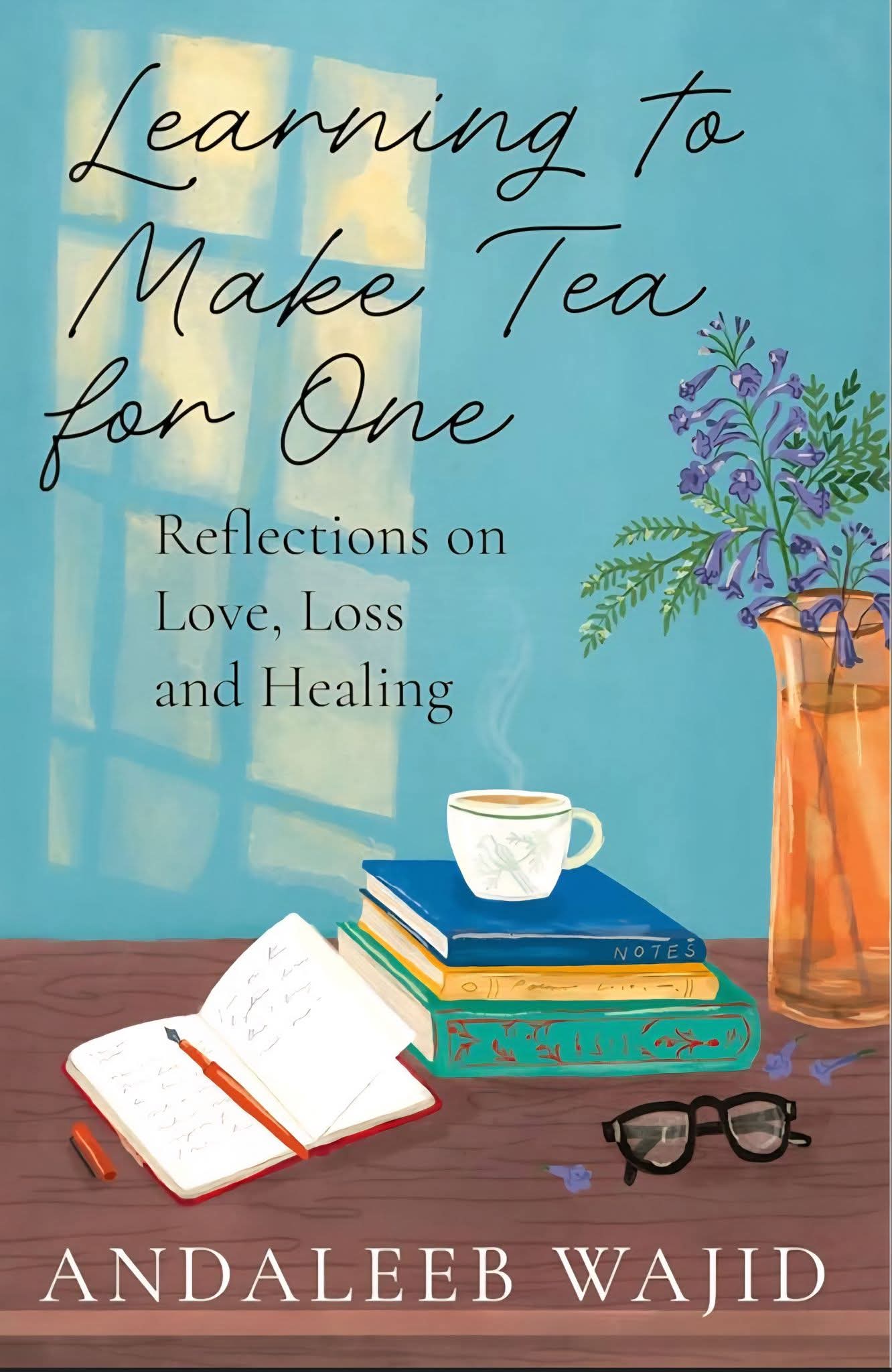
What do you do when you lose the two closest people in your life simultaneously, and have two children to bring up on your own? Andaleeb Wajid answers that in this touching memoir -- an honest, courageous reckoning with her grief after losing her husband (Mansoor) and mother-in-law (who was also her paternal aunt).
The originary grief in her life, however, was losing her father at a tender age -- the father she adored, who could've prevented the early marriage to her cousin (that he had planned but not timed) which was forced upon her while still in college, and the early motherhood that followed, when others her age were still figuring out their careers. Somewhere, in the middle of all this, a writing career emerged, almost accidentally, whose highs coincided with the most excruciating lows of her life.
In the summer of 2021, practically her whole family tested positive for the Covid-19 virus, with she and her mother-in-law being admitted in one hospital and her husband in another. She survived, but they did not. The account of those nightmarish weeks, especially the last days of her dearest ones, is something that probably everyone, especially in India, would relate to. At least, in some measure. Few, however, would've borne the burden of double loss at the same time, as Andaleeb did.
By a strange twist of fate, she was living out the life of her mother, widowed just like her at a young age, with children to bring up. Some of the most poignant chapters in the book are those where Andaleeb revisits her memory of that loss -- both the circumstances leading upto it and its aftermath. In these chapters, she is both daughter and wife, mourning her father afresh through the loss of her husband.
Her mother provided her succour in ways only she could have known. One of the most remarkable aspects of the narrative of Andaleeb's journey of grief is her acknowledgement of the privileges she enjoyed in the formal months of mourning in her natal home. Few would do that, after facing such devastating loss! Another admirable aspect is her awareness of and empathy for the loss of others. Like her sister-in-law, who couldn't be present when she lost her mother and brother, and in fact came after three long years to a home that had changed irrevocably.
The journey of grief, however, is not drowned in sorrow. Andaleeb recalls, in vivid detail, the joyous rituals/experiences of her life with her husband and aunt -- making biryani collaboratively on Fridays; having tea together on her balcony (when her aunt would be rife with gossip about her neighbours); going on Haj (where people said they all looked the same, "cut from the same cloth" - as she had taken after her father, he after his mother, and those siblings had resembled each other)!
In one of the last chapters of the book ('Thriving, not Surviving'), Andaleeb mentions visitors telling her, in the period of her 'iddah', that "I have to hold on, I have to continue to live for my children. I knew they meant it from a good place, but this irked me, because while my children mean the world to me, this implies I have no existence of my own outside of them".
She did have that existence of her own, of course, which manifested in her writing. In fact, the most life-affirming change that happens to Andaleeb is when she wills herself to convert her late husband's home-office into her study; a separate, designated space for writing finally allowing her to give herself formal working hours in it.
One may safely assume that this book was written in that study.
PS: I'd like to thank Zehra Naqvi for recommending this book to me.