

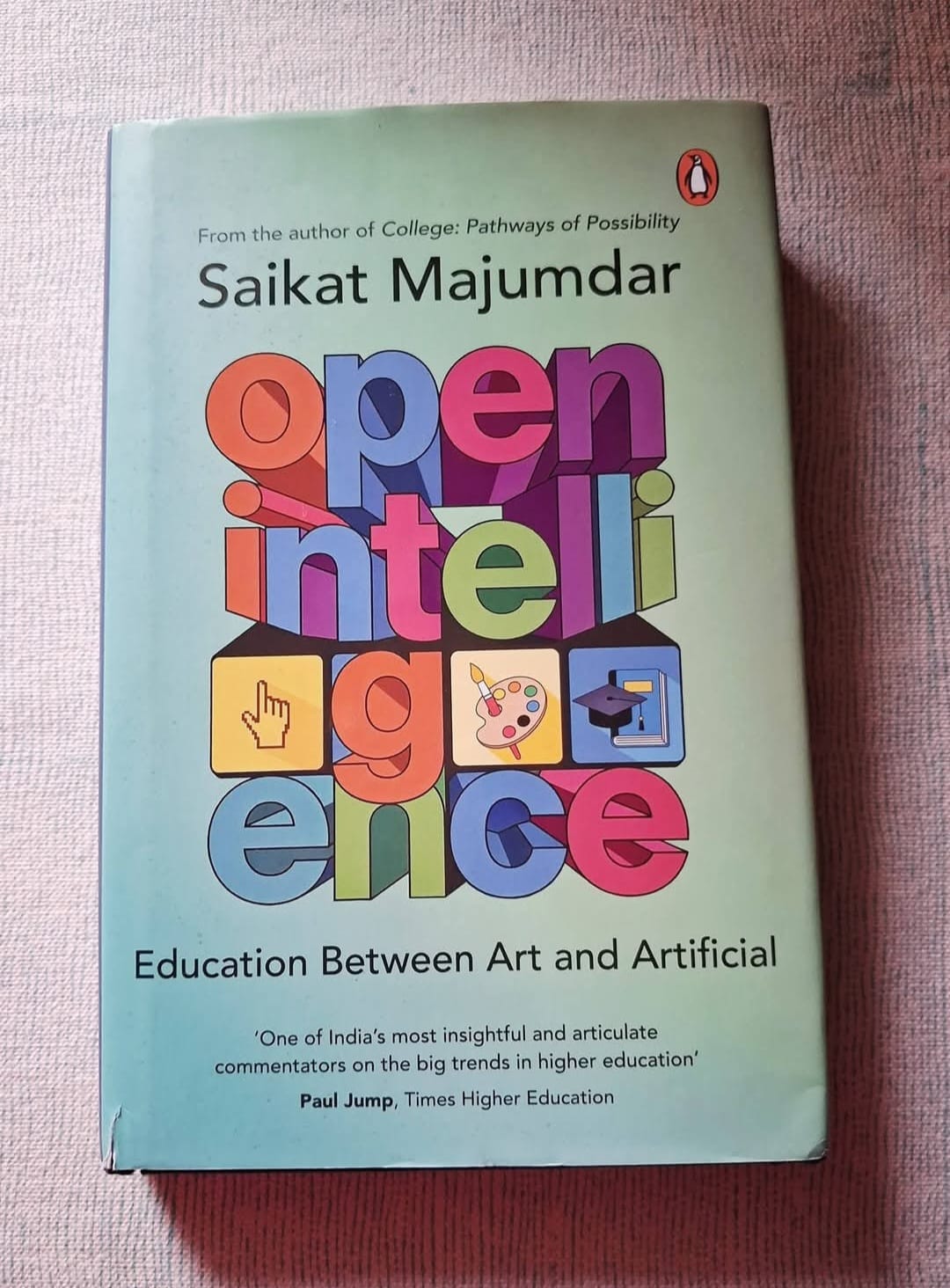
OPEN INTELLIGENCE: Education Between Art and Artificial, Saikat Majumdar's latest book, is best read as a companion to 'COLLEGE: Pathways of Possibility' (2018). Indeed, it's while reprinting the earlier volume that this new one was suggested by Penguin Random House. Both testify (along with his columns on education) to his commitment as an educator beyond the hallowed space of his premiere University and his official designation as 'Professor of English and Creative Writing'. Conversely, it is his foundational work at Ashoka that propelled him in delving into the possibilities of a liberal Artscience education in India. This book is a logical extension of that exercise.
In authoring this book, Saikat has been both teacher and student:
“This book, in part, is a response to all those students grappling with fears of irrelevance in a fast-changing world. But it also tries to speak to the key figures in their lives – parents, educators and the employers who will one day work with them. It is my attempt not only as a design-thinker of language but also as a teacher drawn again and again to the paradoxes of education: its power to liberate and its tendency to confine. To even begin thinking seriously about non-human forms of intelligence and their growing hold on our lives, I had to educate myself across disciplines and doubts. So, this book is also the story of that education, of my immersion into the murky waters of known and unknown intelligences.”
That immersion has served him well. It has produced a timely intervention: a crisp, accessible book in 5 (delectably titled) chapters (with a succinct summary and end ‘Notes’ to boot), it is part handbook and part meditation, imbued with a radical hope for the future – where humans are neither consumed by machines nor anxious of their own relevance, but cohabit ethically with other intelligences while recognizing and harnessing the diversity in their own.
Though Saikat is better known as a novelist (especially as one exploring sexuality beyond heteronormative desire), his non-fiction is equally significant. And both add up to an oeuvre that is remarkable in its continual, wide-ranging and profound engagement with the role that education plays in our lives. One of his students might well explore this connection in a thesis!