

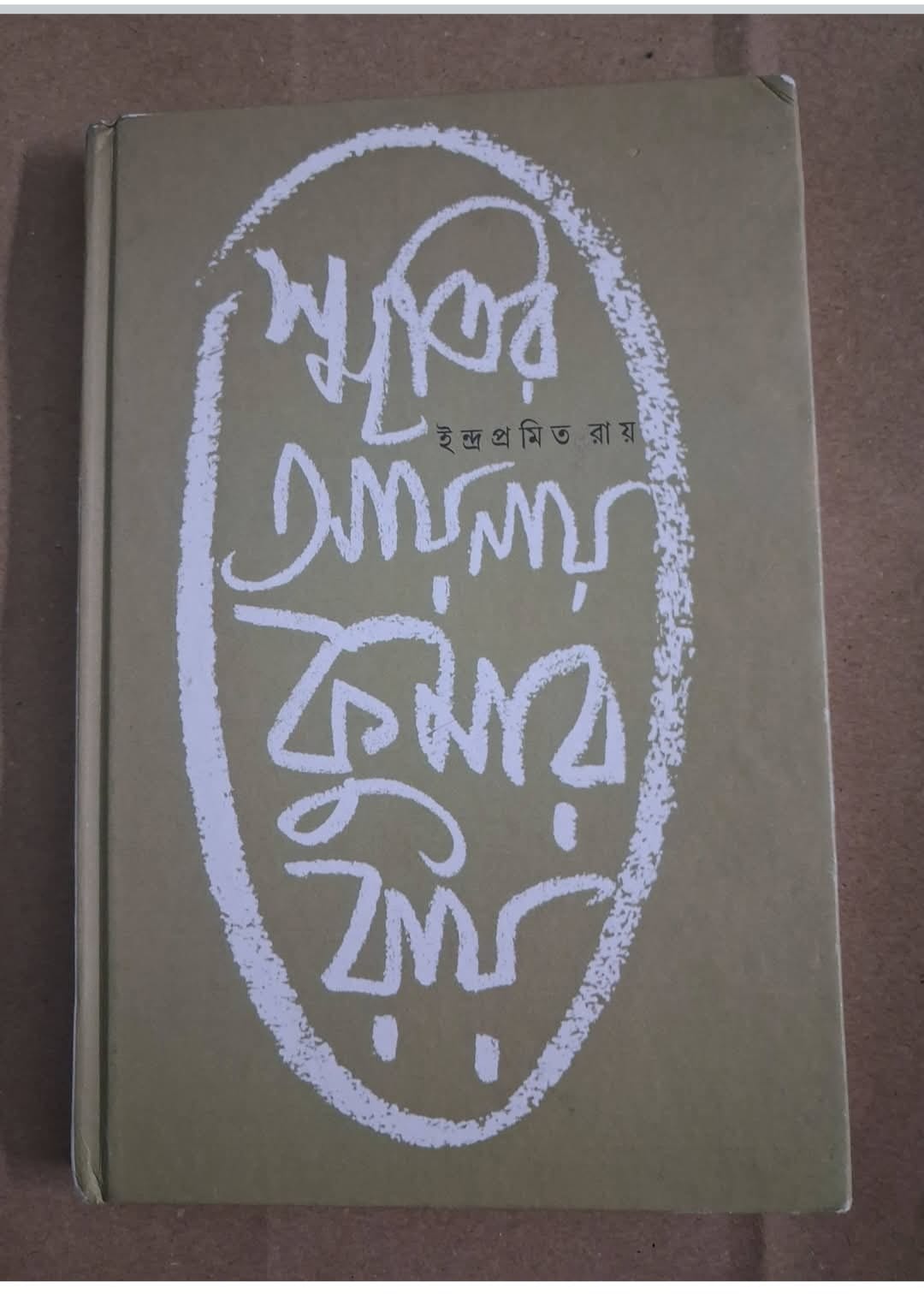
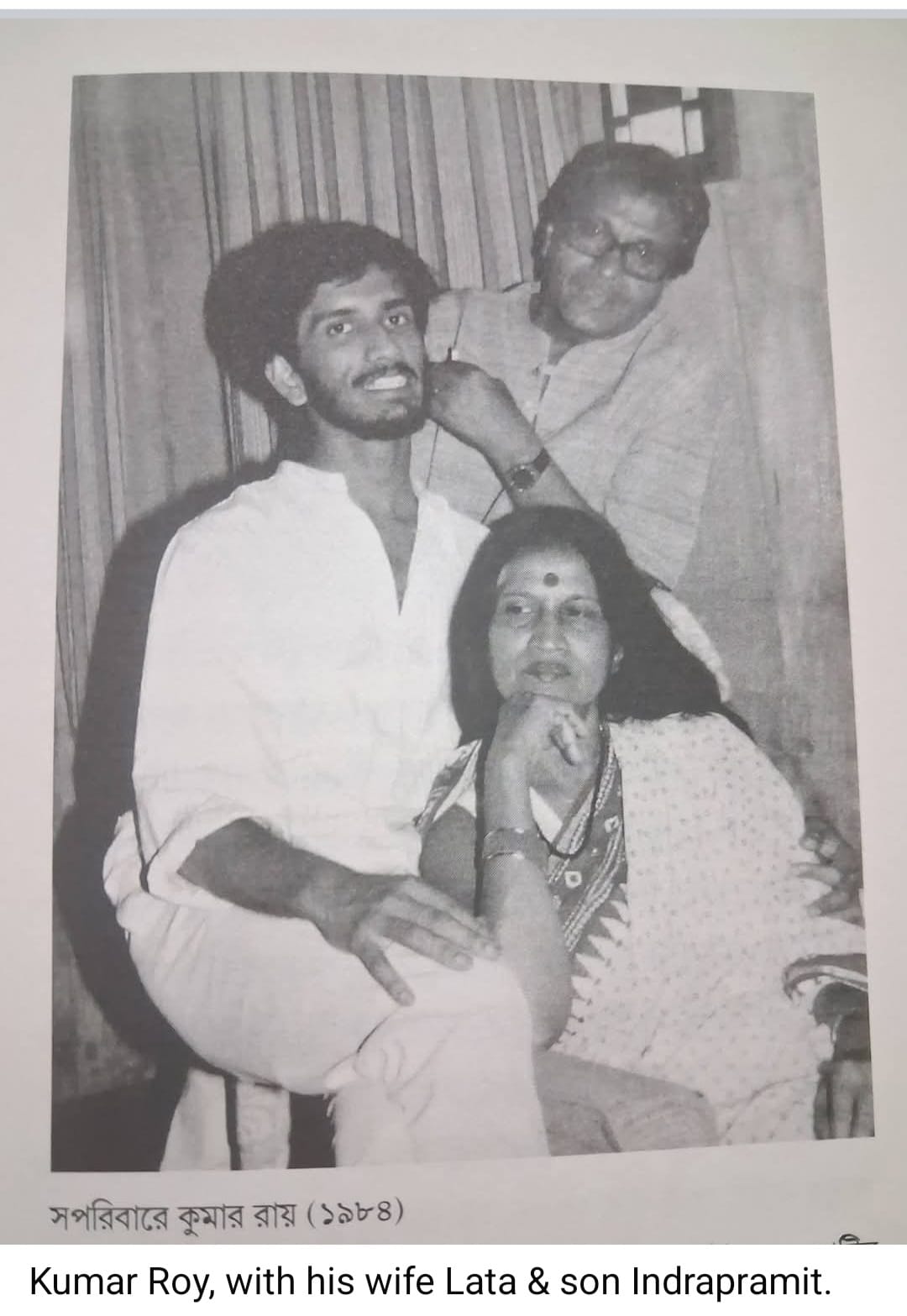
This year marks the birth centenary of the thespian Kumar Roy, who was devoted to the theatre for six decades – throughout being a part of the group Bohurupee, which he joined in 1948 (after a chance encounter with Ritwik Ghatak who introduced him to Sombhu Mitra) and served till his death in 2010. His engagement with theatre encompassed every possible aspect of it - from acting, directing and stage design to writing, editing and teaching - possibly why he looked upon himself as a ‘natya-karmi’ (theatre worker) and not ‘natya-byaktitto’ (theatre personality). It is this ‘karmi’ who comes alive in the pages of his son Indrapramit’s memoir of him – স্মৃতির আয়নায় কুমার রায় (Kumar Roy in the Mirror of Memory).
Written in an inspired fit within a week, this book (published by Debabhasha) is an expanded version of an essay that the author had contributed to the Pujo Sankha (Durga Puja Special) of a magazine. Lucid and spontaneous, it’s a pleasant page-turner that can easily engage even those without a passion for theatre or lack of knowledge in it (like me).
Given that it’s a son’s memoir of his father, one inevitably expects personal anecdotes in it. One of the most endearing ones is that of a holiday in Kashmir where father and son drew together, the father completing what the son had begun. There’s another memorable one from his formative years: once, a teen Indrapramit tried a beef roll (not a usual choice for a Hindu boy in the 70s) with a friend, which the latter divulged to his parents, thinking this would land the son in trouble. In response, the father recommended another joint instead, further up from where they had eaten, which did beef rolls better!
Personal anecdotes are however not the mainstay of the book. Kumar Roy lived and breathed theatre; and at the core of the son’s memories of him is also theatre – as a lived experience that defined every aspect of the life of the family. Kumar could invest in his passion wholeheartedly because of the steadfast support of his wife, Lata. And his son also got sucked into his theatre madness from a tender age. Theatre was not just something the boy saw performed at the Academy (with snacks in the interval) – it was the plays and other writings his father did at the dining table, which doubled-up as desk after meals; the rehearsals and experiments with make-up and costume that he was given privileged access to; and the sheer hard work, dedication and crisis management that went into the running of an organization that he witnessed from close quarters.
The greatest crisis was when Sombhu Mitra left Bohurupee in 1979. It was a huge setback for the group. But instead of caving in to pressure, Kumar Roy rose to the occasion, taking upon himself the direction of Shudrak’s Mrichchakatikam. Galileo (1980), Rajdarshan (1982), Malini (1986) would follow, and many more thereafter, amounting to 22 plays directed by him until 2008; Bohurupee, thus, not only survived, but continued unabated under his able stewardship.
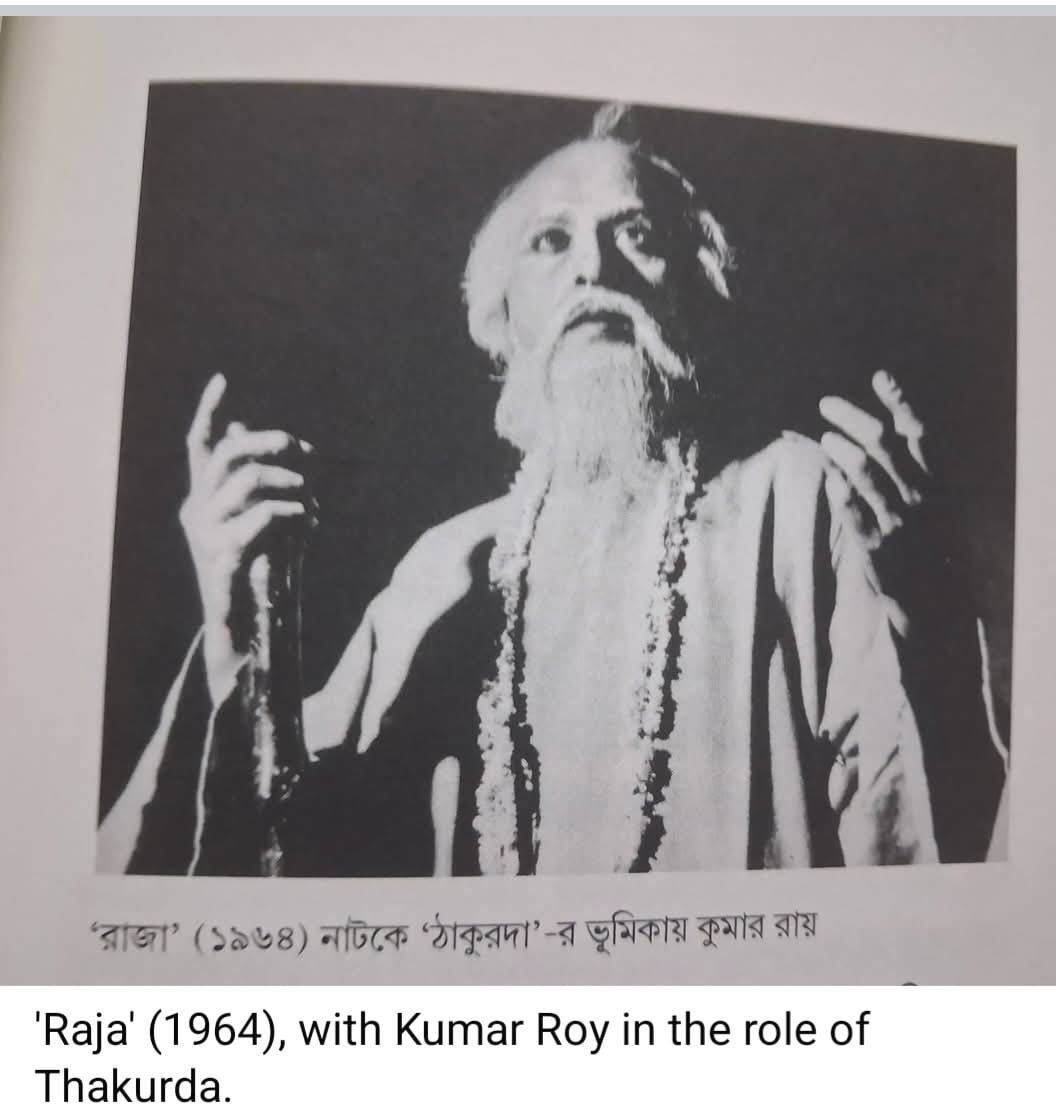
A lot of the book is taken up with the process of producing these plays, both before Mitra’s exit (like Putul Khela, Raktakarabi, Raja Oedipus, Tughlaq) and after it. But as the author looks back to the many plays he saw performed, sometimes repeatedly, he realizes it is Tagore’s Raja that holds a special place in his heart – with the magic of Sombhu Mitra’s voice as the invisible Raja and the arresting make-up of Thakurda (played by Kumar Roy) in the likeness of Tagore in his last days. Certain stage designs also remain unforgettable for him – notably, Mrichchakatikam and Ghare- Baire (1974). When Satyajit Ray auditioned him to play the role of Amulya, the young revolutionary, in his screen adaptation of Ghare-Baire, soon after his Boards, the first question he was asked was whether he had read Tagore’s novel. He had; and he went to the sets of the film with the additional advantage of having seen the stage production as well.
Indrapramit could have been an actor, but he opted for Art – his first love; training in Santiniketan and then Baroda, followed by the Royal College of Art in London (with an Inlaks scholarship). It is interesting that every phase of his life in India - as a student and teacher - had some association with his father’s work: while in high school at Patha Bhavan, Kolkata, his father was invited to direct a play in which he had a meaty part; while at Kala Bhavan, again, his BFA years coincided with a stint his father had at Sangeet Bhavan; and at Baroda, when he was well settled as a faculty member, his father was once invited to speak. Unwell then, he enacted some snippets only with his voice in the course of his talk, and had the audience mesmerized just by that quality, though spoken in a language they didn’t understand!
In the last chapter of the book, the author says: “… In a long journey of 60 years, even after the extensive and diverse work he had done, Kumar Roy never got the acknowledgement and recognition that his distinct talent deserved – not just in his lifetime, but also after his death" (translation mine). It didn’t matter much to the thespian, he then quickly adds. But it’s clear to the reader that it does matter to the son: the book is essentially an attempt to right that wrong, in a personal capacity.
It is this – a child’s intense desire to commemorate the parent – that will resonate most with the reader.