

Inter-faith romance is a staple of Partition narratives. So are certain other elements, especially with respect to the Punjab: the disbelief that people felt about whether it would actually happen, the communal violence that erupted nevertheless where neighbours could equally turn betrayers or protectors, the killing of women by elders in the name of ‘honour’, harrowing train journeys, followed by years of uncertainty and destitution in refugee camps and colonies, missing family members who could never be retrieved, the slow building of lives in the place forced to relocate, and most importantly, inter-generational trauma that resisted closure.
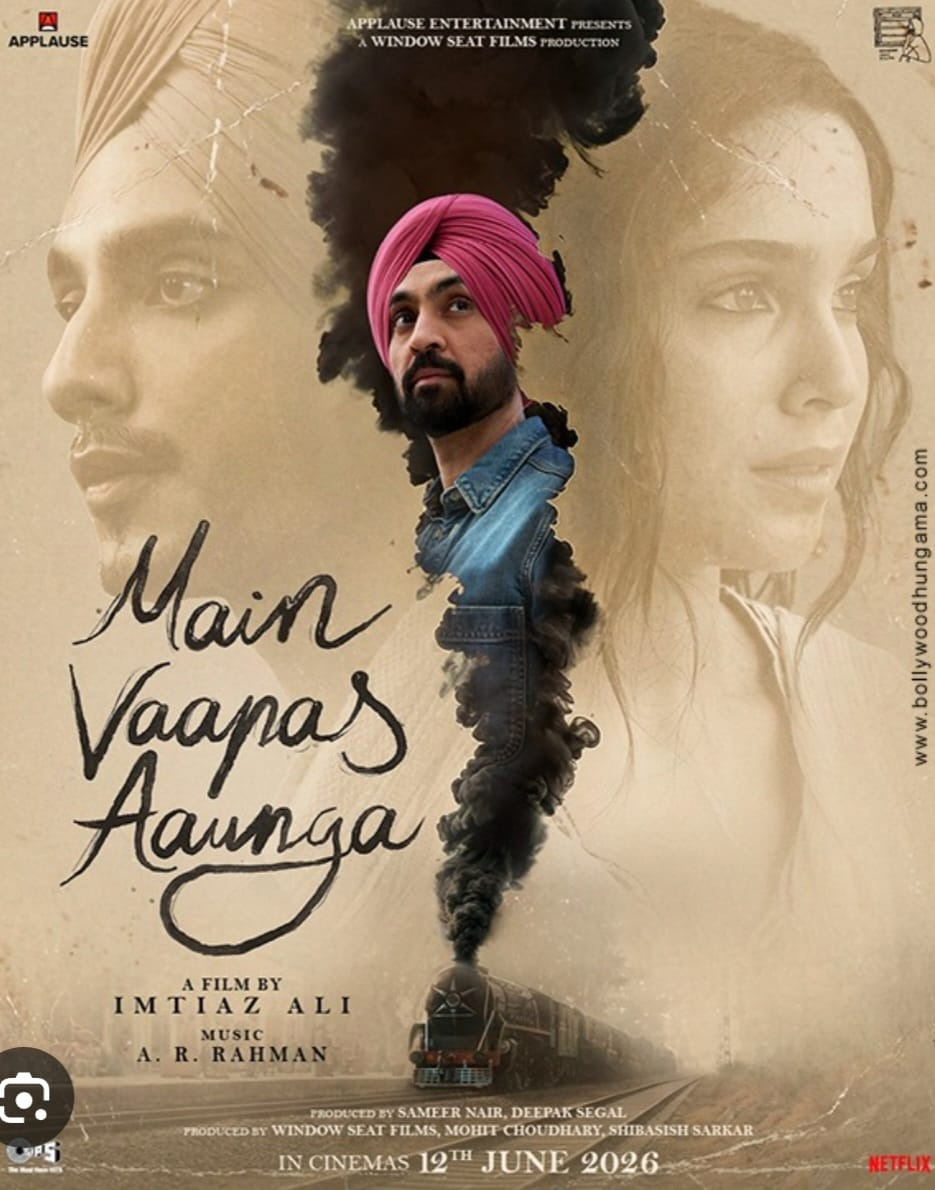
All these elements find their place in Imtiaz Ali's Mein Vaapas Aaunga, the inter-faith romance - between a Sikh boy, Isher (nicknamed Kinnu, played memorably by Vedang Raina) and a Muslim girl, Afsana (nicknamed Jiya, essayed by Sharvari Wagh) - being the pivot around which the plot moves. Had we seen the thwarted romance in the narrative present, we would have empathized with the unfortunate lovers no doubt. But what makes it unforgettable is the searing pain of the nonagerian protagonist (suffering from dementia) when he tries to remember - or rather desperately tries to keep alive the memory of - his lost love. This film is as much about dementia as Partition, as we see a family hopelessly trying to cope with a patient not only in and out of hospital, but also stranded between his past and present, life and death – with the loving grandson as the lone interpreter of his garbled speech and incommunicable dreams.
Nasseruddin Shah as the demented old man lifts the film from being a stereotype by the sheer power of his performance, which can compete with Anthony Hopkins' in The Father (my ultimate benchmark for such a role and subject). Shah can make his presence felt even in cameos (a memorable example being Gehraiyaan); here, he carries the entire film on his fragile shoulders, or rather face – as half the runtime comprises of scenes focussed primarily on his facial expressions, capable of turning even stones to tears, as they emote the double burdens of age and trauma.
Romantic love may be at the heart of the narrative, but the film celebrates other loves as well – the filial bond between siblings, and above all, that of a grandchild for a grandparent. Diljit Dosanjh as Nirvair is both sincere and endearing as the grandson, running away from his own life and unable to commit to his girlfriend in Bradford, but determined to give closure to his Dadaji; the best scenes in the film are where he sits crouched over the old man on his bed, trying to listen to and understand - with humour and patience - the elder's language and vocabulary, and reconstruct his past from it.
There are some problems with the characterization and script. I didn't understand why a young man brought up in Indian Punjab (of all states) didn't know the rudimentary facts about Partition. Going in search of his grandfather's past is one thing, behaving as if he is hearing of Partition for the first time quite another!
The stand-up gigs on Partition history didn't work for me, either. Especially the demonization of Radcliffe. Though I know this is common. Radcliffe was not responsible for the Partition of India; he was executing somebody else's premature decision. Doing the dirty job. And the Boundary Commissions (BC), on whose recommendations the Radcliffe Line was drawn, were complex affairs. Just as Hindu-Muslim relations prior to Partition, and the role of the Indian leadership in it. Partition ultimately transpired because of the failure of the Cabinet Mission Plan of 1946, and that was because the Indian National Congress and the Muslim League had, by then, become incapable of agreeing on anything. The Radcliffe-bashing in the film was particularly jarring in the light of the fact that the Amritsar Partition Museum - which is shown as the chief resource through which Nirvair is able to track down the house of his ancestors in Sargodha in present- day Pakistan - itself gives a different take on Radcliffe, who didn't take any payment for the work he did (seeing the devastation it had caused) and who had to factor in the politics within the BCs while finalizing the border. The film could have easily skipped this part and reduced the runtime. There was no need to feed the audience with history capsules in a feature film. The incorporation of archival footage in the sequences of forced migration was enough for the purpose of this story.
The music of the film by A.R. Rahman has a wide range – from the twist-cum-tappa of Isher's youth (‘Ishq Mastana’)to the rousing anthem of rage by his grandson that accompanies the end credits (‘Kya Kamaal Hai’), where the Partition of India is juxtaposed with the continuing experiences of violence, devastation and displacement in the world.
It's important to note that while the film doesn't avoid violence, it doesn’t revel in its depiction. Its most striking instance is where the matriarch slashes off the heads of all the girls one by one when marauders come for them, the camera focussed throughout on the ruthless face intent on the demonic act in order to salvage ‘honour’ for the girls, the family and the community. The director conveys the full horror of the violence without showing it in gory detail. We hear the slash of steel against skin, repeatedly, but are spared the beheaded spectacle.
The most moving scene, however, is where Isher's younger brother, himself an octogenarian now, lashes out at the extended family eager to know the unheard stories, saying, what his generation has seen and known first-hand has been burnt to ashes, and he has no desire to share that burden with the next. Nirvair contests that view, but the rage with which the old gentleman articulates his pain will stay with me. “Hum bolenge, magar tum samjhoge nahi”, he says.
Sometimes I wonder whether we have indeed understood.