

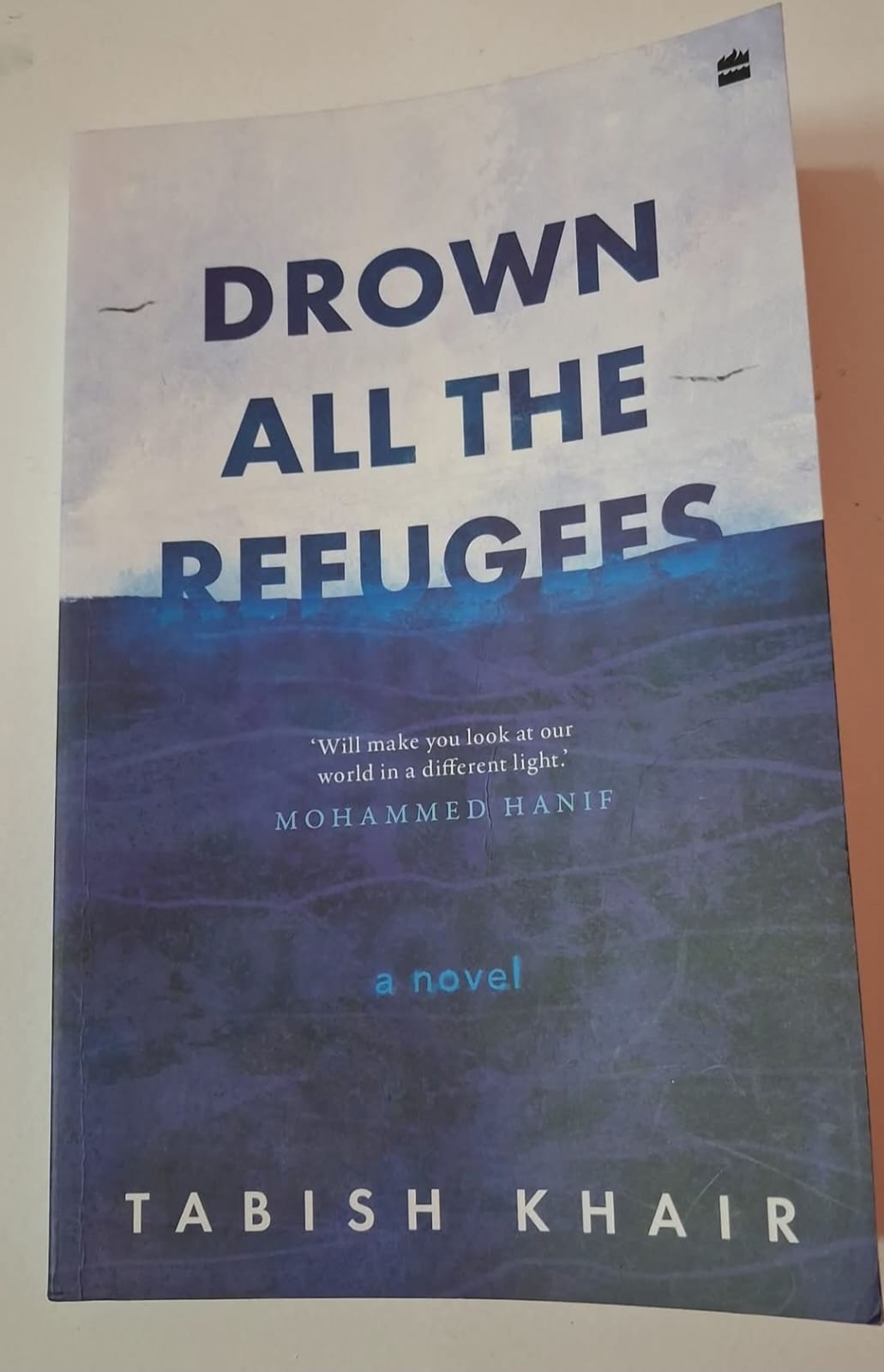
Refugee experience, and the toll it takes - both on those who leave and who are left behind - is at the heart of Tabish Khair’s novel, Drown All the Refugees. Two of the dearest persons in the narrator’s life go through it – his childhood playmate/brother Pedro, son of his nurse Maria; and his Palestinian lover Abdullah. The latter inherits the condition through three generations of political displacement spanning West and South Asia; the former becomes one, trapped in the maze of global traffickers in the illusion of pursuing a better life. When he goes missing - the place is never named, it's suggested it’s somewhere in the Northeast - his desperate mother tries to bring him back by taking recourse to the Occult, mediated by an ancient woman known as the ‘The Midwife’, who tells the narrator: “No one who belongs ever leaves” and that “if you are forced to leave the place you belong to, one part of you stays behind...”.
About half the novel is taken up with the narrator’s attempt to reconnect with his childhood friend (after the death of his lover) through these two women, aided in no small measure by the midwife’s assistant, Compson. It makes for an interesting 21st century take on the Gothic, but the part that I personally found most engaging deals with Abdul. Though he plays only a cameo, the narrator’s relationship with him is far more fleshed out and complex than the one with Pedro. Not only do we get here the nuanced dynamics of homosexual love as it plays out in a remote part of a huge subcontinent, but far more importantly, for the subject of the novel, attests to the kind of layered histories of displacements that the postcolonial era has engendered.
Son of Palestinian refugees who were displaced in 1967, Abdul’s extended family had first moved to Lebanon, then his parents (who were members of the Palestinian Communist Organization) came to Afghanistan, where his father was offered a job at Kabul University. “It was a different Afghanistan [….] a kind that’s almost… extinct these days”. Growing up in an urbane environment, he became part of a communist student organization which was later banned, and he ended up in India. Palestinian by birth, Afghan Muslim by upbringing, and a gay man who found the love of his life in small town India, he is the most fascinating character in the novel; someone “who fled, and fled, and even after he had found shelter… kept fleeing”. I wish cancer had not taken him away so soon!