

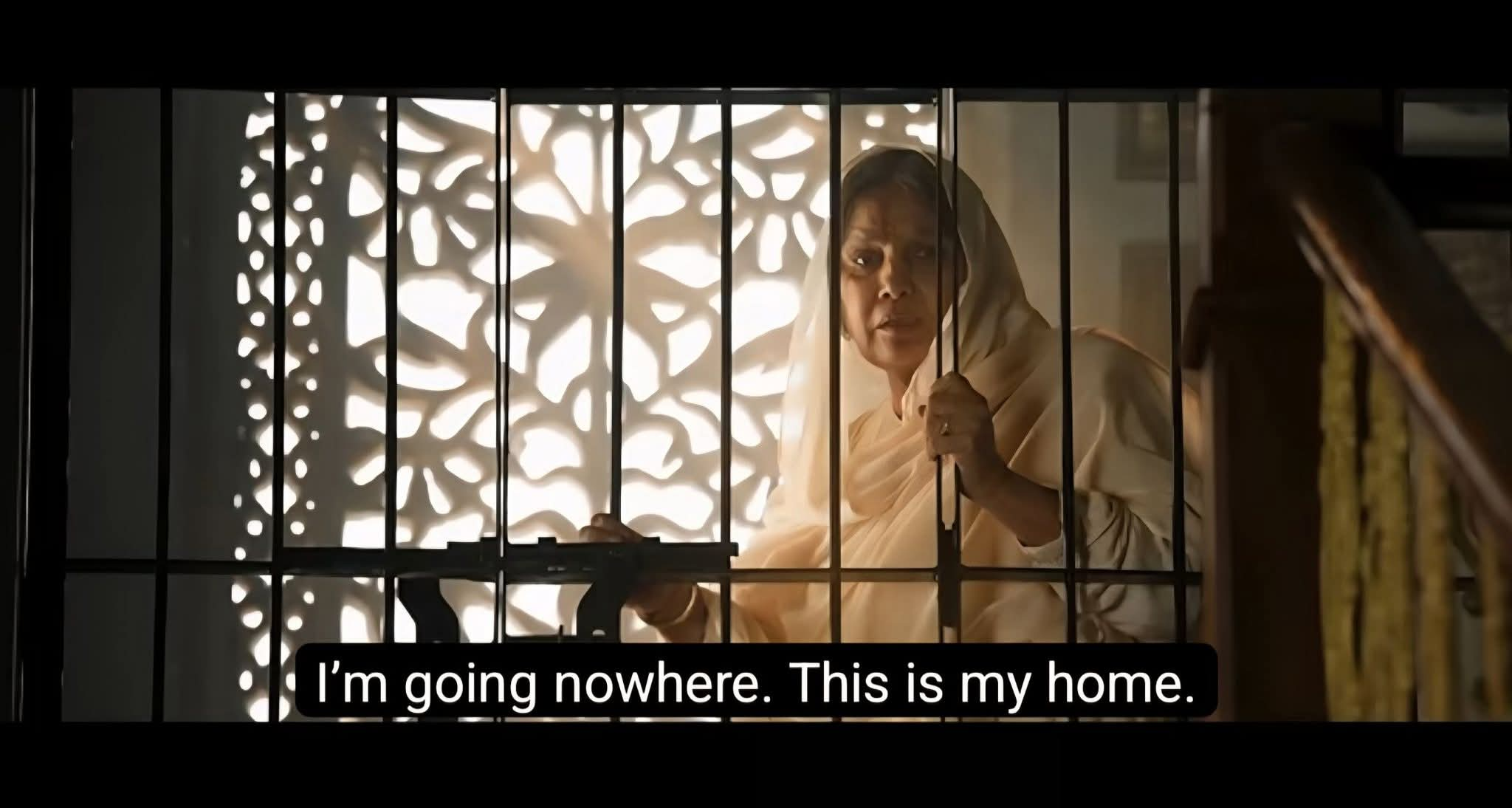
Batwara 1947 belongs to Shabana Azmi the way Main Vaapas Aaunga did to Nasseruddin Shah. While the trailer may focus on the scenes of communal violence in the film, in effect they don't take much of the runtime. And though wherever they occur, the audience is never allowed to forget they are watching Sunny Deol, the (yesteryear) action-star, the narrative is actually woven around the figure of Durgabai, widowed matriarch of a family of jewellers, who simply refuses to leave her home - a grand, 22-room, 2-storey haveli - in Lahore, at the time of Partition.
She is in hiding in her room in the upper storey of the house, waiting for the return of her son and his family (whom she doesn't know are dead), when it is allotted to a Muslim refugee family from Meerut - Sikander Mirza (Sunny Deol), Hameeda (Preity Zinta) and their daughter Tanno - forced to leave their own home suddenly one night, undertake a harrowing train journey, and live in a camp for months while hopelessly searching for their missing son. An accidental meeting with a poet, Habib Anwar (Ali Fazal), and his inexplicable kindness led to the allotment of this house, only to discover that it’s not empty.
Durgabai’s presence is the itchy factor for both this family and the mohalla, especially to an aspiring politician, Yakub (Abhimanyu Singh), who is hell-bent on keeping his land ‘pure’ and has no qualms wiping it clean of all kafirs, no matter what it takes. While there's a transformation in the relationship between the Mirza's and Durgabai, who soon become ‘Mai’ for them, the missing son (played by Karan Deol) however sides with Yakub after reuniting with his family – traumatized by the violence he had witnessed by Hindus against Muslims, especially to the household of their family friend, while missing the train to Lahore.
That changes, too, after matters come to a head when Mirza not only allows Diwali to be celebrated in their home but also participates in it... followed by the death of Mai. While the film has its share of poignant scenes (my favourite is where Sikander comes to know that the space he got for his factory was secretly arranged for by Mai), it is marred by the melodramatic treatment of all the crucial moments, with Mirza frequently lecturing on who is a Muslim and what constitutes Islam. In stark contrast to these long declamatory speeches (usually in confrontation with Yakub), are the quiet kindnesses of the Imam and the poet; and their soft-spoken yet firm secular stand. Ali Fazl as the poet is the surprise of the film; pity, he is wasted as a cameo!
What is heartening this Partition ‘season’ is the fact that two Bollywood heavyweights - Imtiaz Ali and Rajkumar Santoshi - chose to tell stories that underline humanism in times of barbarity; that focus on memory, love and kindness when hate and violence can easily secure box-office returns.