

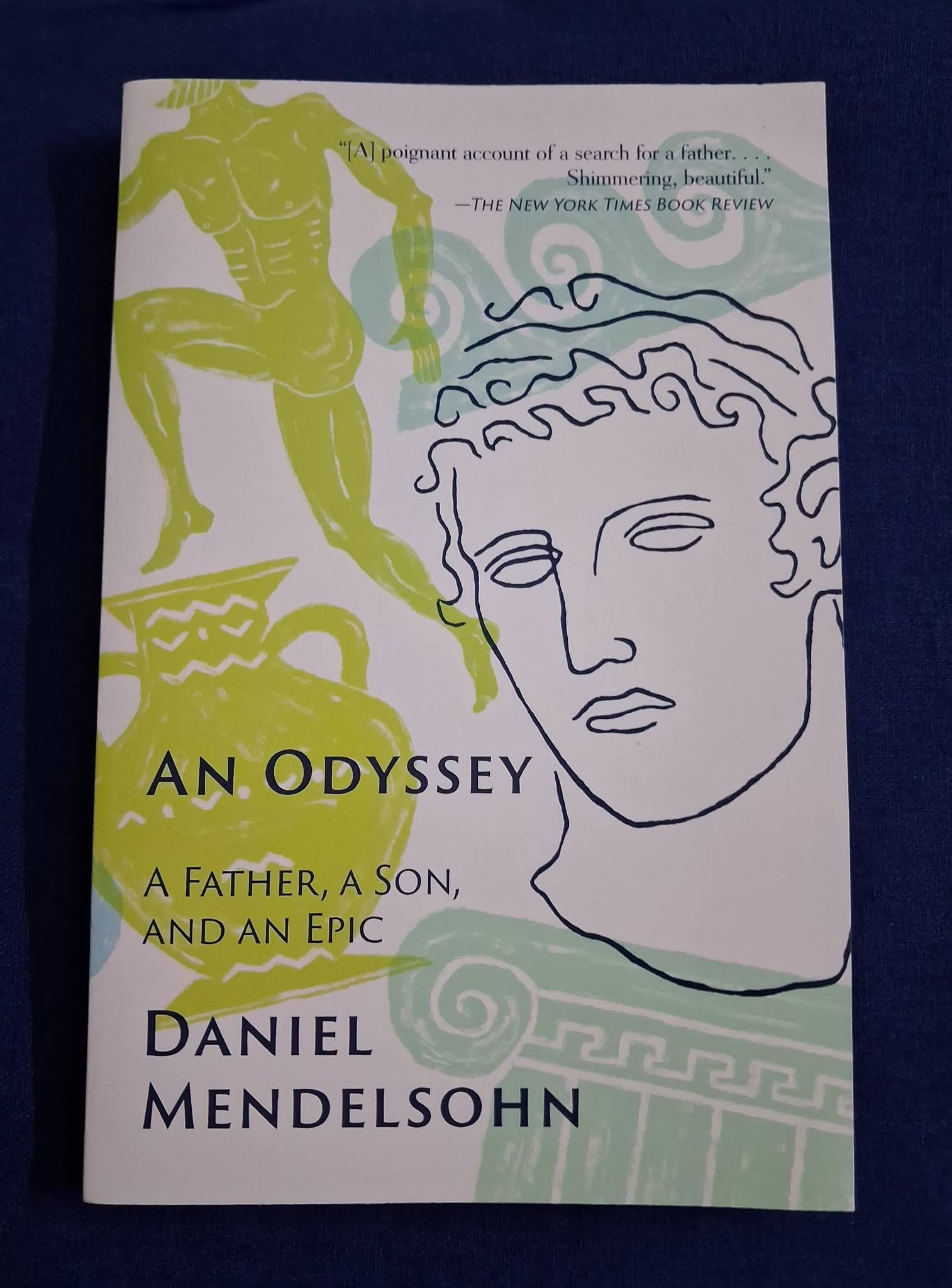
Christopher Nolan's ODYSSEY brought me to Daniel Mendelsohn's memoir - 'AN ODYSSEY: A Father, A Son, and an Epic'. Initially looking for videos of film-crew interviews, I chanced upon a conversation with Mendelsohn on his translation of the epic, which in turn led me to the book.
Mendelsohn deftly braids four strands in it: Homer’s epic, the experience of teaching it in class with his 81-year-old father in one of his Seminars, going on a curated cruise with him that traced Odysseus's adventures, and the transformation in their own relationship during this phase.
The epic, in class & cruise:
Divided in 6 parts - Proem, Telemachy, Apologoi, Nostos, Anagnorisis, and Sema – the memoir reads like different genres within the folds of a single book. While reading 'Proem' (Invocation), for instance, one actually feels like being taught, as Mendelsohn elaborates on what a Proem is, and goes on to compare those of the ILIAD and the ODYSSEY with that of the AENEID.
The experience Mendelsohn shares is that of teaching a Seminar, where students are required to read the text in advance and discuss it in class with their teacher. While what they discuss about the poem as they go along is an integral part of every chapter (making the book literally a course on the epic), 'Telemachy' (Education) in particular reads like a novel -- with a lot of the conversation in class reproduced in dialogue form, without quotation marks (this is there in the other chapters too), and the students themselves being introduced as distinct characters with their names being marked with some physical feature/idiosyncrasy they have (Jack of the Dimples, Nina Dark-Eyes, Don Quixote Tom). It's here that they are seen warming up to the text -- as Telemachy constitutes the first four books of the ODYSSEY, focussing on Odysseus’s son Telemachus, as he goes in search of his father to Pylos and Sparta; distressed at the chaos in king-less Ithaca (where a horde of Suitors were trying to manipulate his mother Penelope into marriage) and his helplessness to do anything about it. There are heated debates in class about what kind of education Telemachus was actually having; one of many such in the book.
‘Apologoi’ (Adventures) is taken up with the cruise (Retracing the Odyssey) that Daniel takes with his father Jay during the Spring Break while teaching his Seminar on the ODYSSEY, interweaving it with the Books in the text (Books V-XII) that deal with them and the provocative sessions he has with his students about them. The four strands of the memoir come together most directly in this chapter. His greatest takeaway from the cruise is that he gets to see a different father: “Perhaps this expansive and charming person, so different from the crabbed and coiled man whom only a month or two earlier, I ruefully thought, my Odyssey students had come to know, this song-singing old gentleman who could be so affable and entertaining with total strangers on a ship in the middle of the sea, was the person my father had always meant to be”. Ironically, their ship cannot reach their destination - Ithaca - and as a kind of creative compensation, the crew organises a reading session, where the author reads out his translation of Cavafy's famous poem.
‘Nostos’ (Homecoming) comes to the heart of the Odyssey. While the adventures of Odysseus are the most well-known part of the epic, Odyssey is essentially about the return of a victorious but war-ravaged hero to his home and kingdom. It just so happens that he gets waylaid on the journey back and has all these adventures beloved of children (often read as abridged graphic narratives). “It is like Star Trek”, the author had said in an interview, “all these strange creatures and people with weird habits... and that’s fun”. But he is a man who needs to reclaim his identity, and for the entire second half of the epic we see how he goes about doing that.
When Odysseus finally returns to Ithaca, he is in disguise (as advised by the dead Agamemnon whom he meets in Hades). ‘Anagnorisis’ (Recognition) focusses on how he reveals himself there gradually or gets recognized by others. It's his faithful dog, Argos, who first recognizes him and dies immediately after. He then reveals himself -- first to his son, then his wife, Penelope, and finally his father, Laertes. But he is also recognized by his nurse, Eurycleia. While preparing him to meet the Queen, she sees the scar on his feet which he got while hunting a wild boar.
This is one of the many instances in the epic which involves a ring narrative. When Eurycleia recognizes him, Homer doesn’t stop there. He takes us back in time to the hunt where he got the scar, which had happened at Odysseus's maternal grandfather Autolycus’s place, and then back to when he was a baby and Autolycus was visiting and Eurycleia had insisted that he give a name to his grandchild. The scar thus defines him, as his identity is revealed through it.
The elaboration on the ring narrative is significant, as it is an important narrative strategy in the memoir. It eddies out and circles back constantly, with Mendelsohn continually drawing parallels between the epic and his and his father’s lives. A fine instance is that of the marital bed in the last chapter, 'Sema' (The Sign) -- where Odysseus's ultimate test to prove his identity to Penelope after 20 years of absence and his father’s last days with his mother are interwoven.
Teachers:
AN ODYSSEY is memorable for the many portraits of teachers we get. There are Daniel’s own teachers who taught him Greek, who set him on the path to where he is today, as an academic and translator. He speaks particularly fondly of Froma Zeitlin, with whom he has always shared a special bond. It is she who suggests the cruise to him; he accepts right away, confessing disarmingly, “Froma is my teacher and I’m in the habit of obeying her.”
The other teacher who shaped Daniel is Jenny Strauss Clay. “You can’t begin to write anything until you’ve read everything”, she’d told him once, making him aware for the first time of the nature of intellectual lineage – of how what he was studying could be stretched back to many centuries of scholarship, of an uninterrupted line of scholars whose commentaries contributed to the evolution and interpretation of the classical texts. It’s also to her that he turns to in a fraught moment during teaching the course: challenged in class with a different interpretation and accused of forcing his on the students, he finds that several subscribe to a kind of theory proposed by one of them – that, it’s quite likely that Odysseus is making up the stories he tells in ‘Apologia'; stories that are simply nightmare versions of the adventures he has already had (Circe resembled Calypso, the giant Laestrygonians the Phaeacians who set him off to Ithaka). Froma rests the case by quoting a particular line from Book 8, which is evidence that it is not so – that Odysseus didn’t make up the stories. He did have those experiences. “The text is the text, it says what it says. The answers are there. You just have to read more closely”, she tells him.
Another teacher who stays with the reader belongs to the previous generation. During the cruise, in which several middle-aged men and women had come with their elderly parents, Daniel and Jay got friendly with a woman and her father. This gentleman related a story from his childhood in Brussels, during WWII. It was the last winter of the War, in 1944 – a winter of terrible cold and great hunger, referred to by the Dutch as ‘The Winter of Tulips’, as people were digging out tulip buds to eat in their desperation owing to the unavailability of food. This boy’s family was well-off and sheltered many; among them, his tutor of Latin. When he accidentally hit his leg with an axe while trying to chop wood - something he had learnt only recently but was too young and weak to do well - he fell seriously ill, delirious for days; it was his tutor who sat beside him night and day, reading the Odyssey to him in Greek. “He was reciting the Classics all the time, just to have the sound in my head. […] I think that hearing that sound, the sound of a human voice reciting poetry, helped me to heal. […] So I feel in some way the ODYSSEY saved my life.” The cruise was thus his homage to his teacher.
Learners:
The most avid learner in the book in Jay Mendelsohn – not just the octogenarian father who signed up for a course with his son, but also the boy Jay, and the adolescent Jay, and later Jay the young man and father. We get to meet these avatars in different parts of the book, brought to life by the recollections and random associations in his son’s mind, and through the anecdotes of his siblings, friends and wife (which yield a wealth of new information about his father to Daniel and some valuable insights into his character and their relationship). Growing up in poverty in the Bronx, Jay was fierce in his determination to give himself an education and got conscripted during WWII to do just that, as the GI Bill promised it. One of his brothers was in active service, while he “peeled potatoes” (as he never tired of saying) to fulfil his aim; but he was the “smartest of them all” in the army, according to his brother. He was also the brightest in his secondary school and had qualified for the best high school in town, but didn’t go there because his bestie couldn’t. He studied Classics during this time (he was particularly proud of having read ‘Ohvid’), but didn’t pursue it further, something that would haunt him for the rest of his life – even though he built a successful career as a research scientist – and ultimately land him in his son’s Seminar. An incomplete Ph.D degree also remained a regret: he had done the coursework, but he had married young and his wife was pregnant with their first child then, so he couldn’t continue, as he had to earn a living to support his growing family. He supported his children’s education wholeheartedly, though, and was pleased when Daniel chose to study the Classics.
Jay was a voracious reader all his life, and brought to it a quality of independent thinking that became manifest in the course he took on the ODYSSEY. He vehemently refused to accept Odysseus as a “hero” – this man who cheated on his wife, cried (unimaginable/unacceptable for a soldier as far as Jay was concerned), was constantly being assisted by the gods in his decisions and actions, and couldn’t even bring his men back home! Sitting in one corner of the classroom, away from the other students less than one-fourth his age, he gave his son a pretty tough time all through the 16 weeks of class. He softened somewhat only towards the end, conceding that Odysseus exercised remarkable “control” in the scenes where, having returned to Ithaca in disguise, he doesn’t reveal himself to his son and wife right away.
But the time they come to the final book of the Odyssey, Jay had become friendly with his younger classmates, with a few of whom he commuted back home on some days after class. Daniel’s students sent him glowing notes about his father and what his presence had meant to them while studying the epic. Soon after the course, unfortunately, he met with an accident and passed away not long after.
At the beginning of the course, Daniel had thought of writing a humorous piece for The New York Times for what (he had a hunch) was going to be an interesting experience. It turned out to be an unforgettable one, and became the basis of this book.
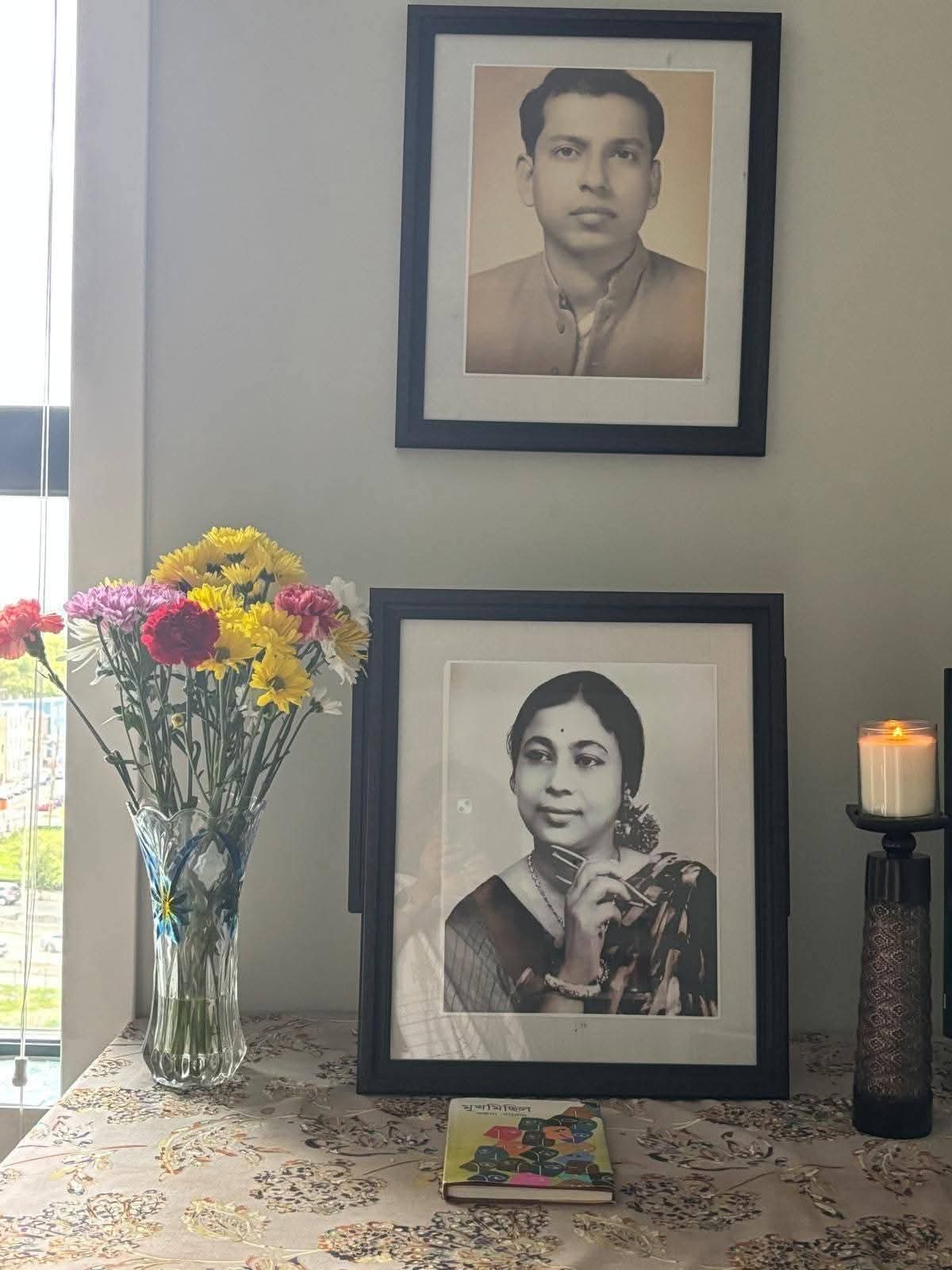
This piece is in honour of my late parents, Prof. Birendra Narayan Roy & Prof. Kalpana Basu Roy, who instilled a love of learning & teaching in me. The greatest joy I gave them was when I formally joined their profession; to my father, in particular, as it was also that of his father’s. Had they lived… and retained their faculties, I would’ve had a long discussion about this book with them, especially with my mother.