

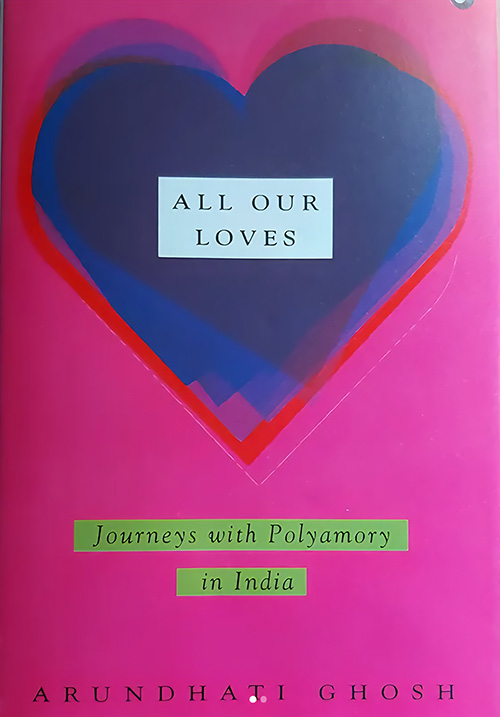
The blurb was arresting enough: "ALL OUR LOVES: Journeys with Polyamory in India is an eye-opening book on polyamory—the practice of being in love with or without sexual intimacies with more than one person simultaneously, with the consent of all—in India."
But I read the book out of a curiosity that was first born after encountering a personal essay on the subject by the author in Outlook magazine some time back. It was truly eye-opening for me, then, to read about a way of being and loving that was beyond my experience and understanding of love. That essay, in a way, prepared me for the book.
As with the essay, so with the book, what is most striking is the honesty of the author and her courage to come out with an identity that is, in some ways, even more marginal and vulnerable than queer sexuality.
In fact, when is the right time and how best to come out is one of the many issues discussed in this part memoir, part handbook. The handbook, however, easily overshadows the memoir. There is a messianic impulse at work here; an overwhelming desire to 'help': help practicing polyamorists navigate the complexities of their lives and relationships; and help mono amorous people understand polyamory and its practice.
The structure of the book also speaks to this compulsion. Framed by the central metaphor of love as an unfathomable ocean (with its three sections titled ‘The Shape of the Ocean’, ‘Sailing with Many Loves’ and ‘Lighthouses in the Mist’), it invests two introductory chapters on non-monogamous cultures and the beliefs and misconceptions regarding polyamory, and rounds off with a vocabulary and ten resources on the subject. Not just that; all the three sections include interviews with a range of polyamorists to give a broad idea of the lived practice. They follow the memoir-chapters in the different sections. Some of these stood out for me; foremost among them being the one with Aravind Narain (in 'The State's Carrot, the State's Stick: The Legal Framework'). Narain was a part of the team of lawyers challenging section 377 of the IPC right from the HC in 2009, to the SC in 2008. FILLER.
Two other memorable interviews were that of a gay couple in Delhi - a landscape architect and a contemporary dancer-choreographer - with an age difference between them (‘Honesty has burdens too, that other people have to bear'); and another of an educator in Zurich and an IT professional in Kolkata ('The Bulwark of Love is Enough to Get us Through'). These two highlight aspects of a love relationship that are not exclusive to polyamory: in one, a couple, though devoted to each other, are manifestly at different places - emotionally - in their relationship; in another, the lovers are continents apart and the physical long distance proves very challenging for them, with one of them consciously making an effort to try and spend more time with her lover, making adjustments in her career.
Another crucial aspect in which I found polyamory not very different from monoamory is how jealousy plays a part in it – at least, in many of the examples given here. Given that, fundamentally, polyamory is premised on a non-exclusive, non-ownership concept of love, ideally speaking, it should not harbour any jealousy in it. But turns out that it does – even when people, in principle, believe in and desire multiple loves. The author herself points to this gap between theory and practice, and says that it is not talked about enough.
What I would have liked to know more about is parenting as polyamorous people. There is a substantive section on being parents of the experimental young in Chapter 9, but very little on polyamorous parents – save for a single page in Chapter 3, that made this (co-)parenting sound like a breeze. An interview here, with practicing co-parents, could have opened up challenges and nuances that the experiences of lovers have given us in other parts of the book.
And I would have loved to read an interview with one of the author’s dearest ones – outside the ambit of lovers. One of her closest friends, may be, who has always stood by her. Or, her mother. She has shared several anecdotes about/with her mother, of the latter’s responses to her life and choices. It would have been great to know her evolving experience and identity, over a span of three decades, from her mother’s perspective. For, it’s as much a journey for the parent to love and accept the child just as she is, and respect her choices in life. I’m reminded of Rituporno Ghosh’s ‘Chitrangada’ here (though that film was about gender fluidity) – how the parents, especially the mother, was the real anchor in the protagonist’s life. Not the lovers who came and went.
Lastly, though I respect the handbook part of the book – it was perhaps essential in a first Indian book on polyamory – I feel a straight-out-memoir would have had a more direct appeal, as the narrative would not have been pulled in different directions all the time. Though conceived intelligently, the reading of ALL OUR LOVES is rather jerky, because of multiple transitions in the different sections.
But Ghosh has undoubtedly led the way where others will, in all probability, follow. Just as queer literature has blossomed in the last few decades, there might well be an efflorescence in polyamorous narratives in the years to come.