

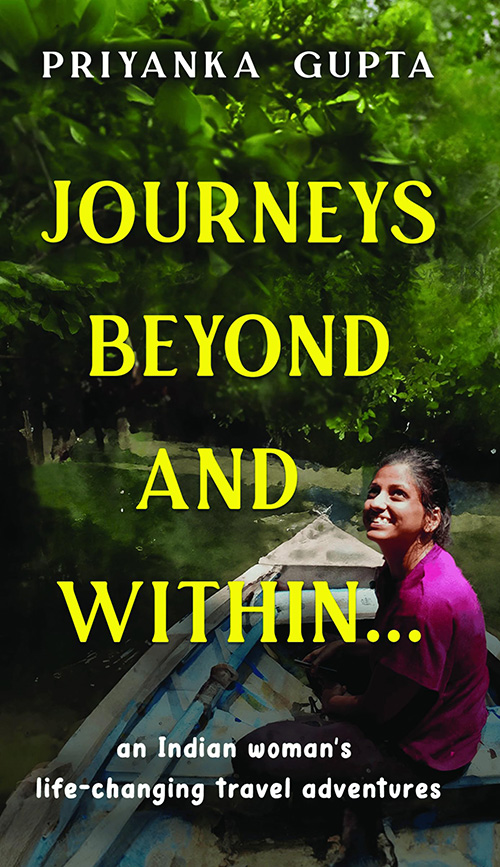
Priyanka Gupta’s Journeys Beyond and Within…an Indian woman’s life-changing travel adventures, its blurb tells us “is the travel memoir of a small-city girl who never dreamt of travelling the world”. What shines in the book, above everything else, is the determination of this young Indian woman (who began her writing life as a blogger) to push against the boundaries set for her.
Gupta’s journey for a better life from a small town in UP (which she never names) to IIT-Delhi, via Kota - on the strength of good grades and the ability to slog relentlessly for years - will probably have parallels with that of many young aspirants (though no two lives are ever the same). Young men and women of her generation, in their 20s and 30s, leaving successful and high-paying jobs to begin start-ups and doing their own thing is also something we get to hear often these days – especially if they become millionaires, the ultimate yardstick of 'success' in our times.These two templates, however, combine in her life to create a third not-so-common narrative – of leaving a corporate life in search of oneself, without a clue where it will lead.
An adventurous spirit
That she had always had the adventurous spirit in her is established early with an anecdote from her childhood: as a mere baby of few months, she would be restless in the evenings once her father returned from work, unless he gave her a ride on his scooty. She had no fear, her mother would recall.It was that little unafraid self, buried subsequently by the conditioning of a patriarchal society, whichshe extricates out to become the person she wanted to be. But the real impetus for the journey outward was the threat of marriage (which she had absolutely no inclination for) looming large ever since her young adulthood,and becoming ever louder in her late 20s and early 30s – with her parents simply unable to understand, far less accept, her increasingly itinerant lifestyle.
We travel with Gupta to many places, within India and abroad: to Goa and Kerala; to European capitals (Paris and London), and then to South America (Chile) and Southeast Asia (Bali in Indonesia, and the Taman Negara forest in Malaysia) – replete with new friendships, adventures, and even an accident.
Chile (‘Cheek to Cheek with Chile’ in Part 3 – Flying Far Away) constitutes the longest of the five sectionsof the book, necessitating subheads.Gupta had gone there as one of 50 international volunteers, to teach English as a second language to government school students for four months – as part of the English Open Doors Program (EODP) run by the Ministry of Education of Chile and the United Nations Development Programme. A week’s training in Santiago preceded their actual work in Chiloe. While the program was challenging, especially as she had to learn Spanish in a short span in order to be able to teach the kids English, friendships with four other women made it an overall enjoyable experience. Teaching, however, was only an excuse to explore South America; and nothing was more beautiful than when she was (what she terms) ‘Inside Neruda’s Chilean Forest’. One moment from that encounter would stay with her:
When going further meant risking being in the forest in the dark, we turned around, fetched our bikes, and started descending. The slope that made us sweat when we were face to face with it was on our backs and under our feet pushing us down.
The bike flew. I flew with it too. I held its wings, raised my being, and laughed into the wind. The soft-spoken Sky [her companion] shouted from behind, “Slow down, Pri.” I didn’t.
Sometimes I lose my eyes and imagine myself gliding down the mountain. The Andean wind blows my hair and whispers her cold secrets in my ears. I am again as invincible as I was in the ancient forests of Chile.
Home
While these travel chapters are supposed to be the USP of the book, as highlighted in its blurb, and indeed in the very fact that it is a travel memoir, it is however those dealing with Gupta’s home in India that are the best realized in the book. The very first chapter, ‘Adventures Begin at Home’ (in PART 1 – Growing Wings) is the most memorable, with her detailed evocation of small-town life, its slow pace, its limited resources and overall conservative environment, the quotidian rhythm of her household, and the people - her family and neighbors - who make up her small world. Among those who stand out are: an aunt (a neighbor) who proclaimed to be her birth mother, in the terrace of whose house she had her first taste of freedom; and, surprisingly, ‘Bhaiyyan’,her father’s helper at his shop, a migrant laborer from Bihar, who lived in one of the four godowns on the ground floor of their house. Every Tuesday, on the shop’s weekly day off, he would invite little Priyanka for dinner. “He called our meals dawat, Hindi for a feast”, she says, and then proceeds to recount it with a tenderness missing in any story involving her own family members.
Her IIT-Delhi years are also narrated with candor:
The courses kept me on my toes. In four years, classes, labs, assignments, projects, quizzes, deadlines, and tests squeezed everything out of me. Week after week went by in a blink. Before we knew it, we were at the mid-term examinations, and before the summer could turn into winter, the semester came to an end. I spent the long winter and summer breaks at my parents’ home. After the second year, even those changed into internships and campus placements. […] Before I knew it, all of us were in the last semester with secure jobs. College was ending. If I had been aware of the social claws scratching at the campus walls – life after graduation was expected to be a marriage-car-child photo series – I would have stayed inside forever. I was relieved to exit the IIT gates. Computer Science and I had failed to become friends. Embarrassed of repeatedly reminding my father to deposit the fees every semester, I was eager to start the job that would free me.
The ‘Journeys Beyond’ in Gupta’s travel memoir are interesting to read; those ‘Within’ are, however, dealt with rather dismissively – as mere appendages to chapters, that read like an afterthought. Of course, the evolution of the self - over the course of the many travels abroad, as well as within India - is evident, but not sufficiently articulated.
When she returned home to India after her South American adventures, there followed a relative period of quiet, when her parents and she were trying to accommodate with each other’s vision of life. She found herself appreciative of the warmth and familiarity of home -especially the comfort of home-cooked meals by her mother - even as she was still mentally steeped in her time in Chile. “I unearthed my memories of India [after returning]” she muses at one point, “but they had alloyed with elsewhere”.
This alloy is the best gift of travel.