

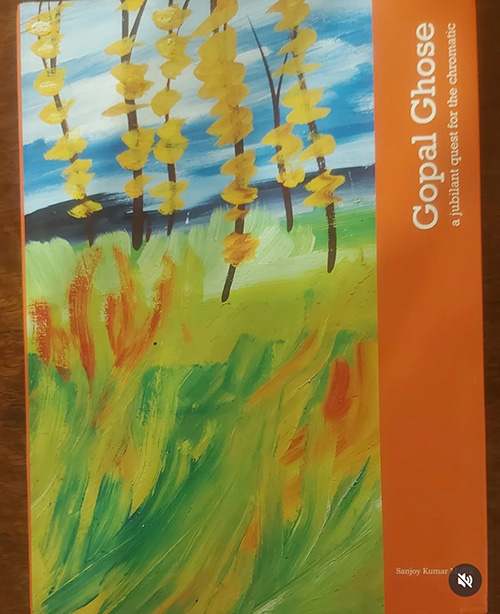
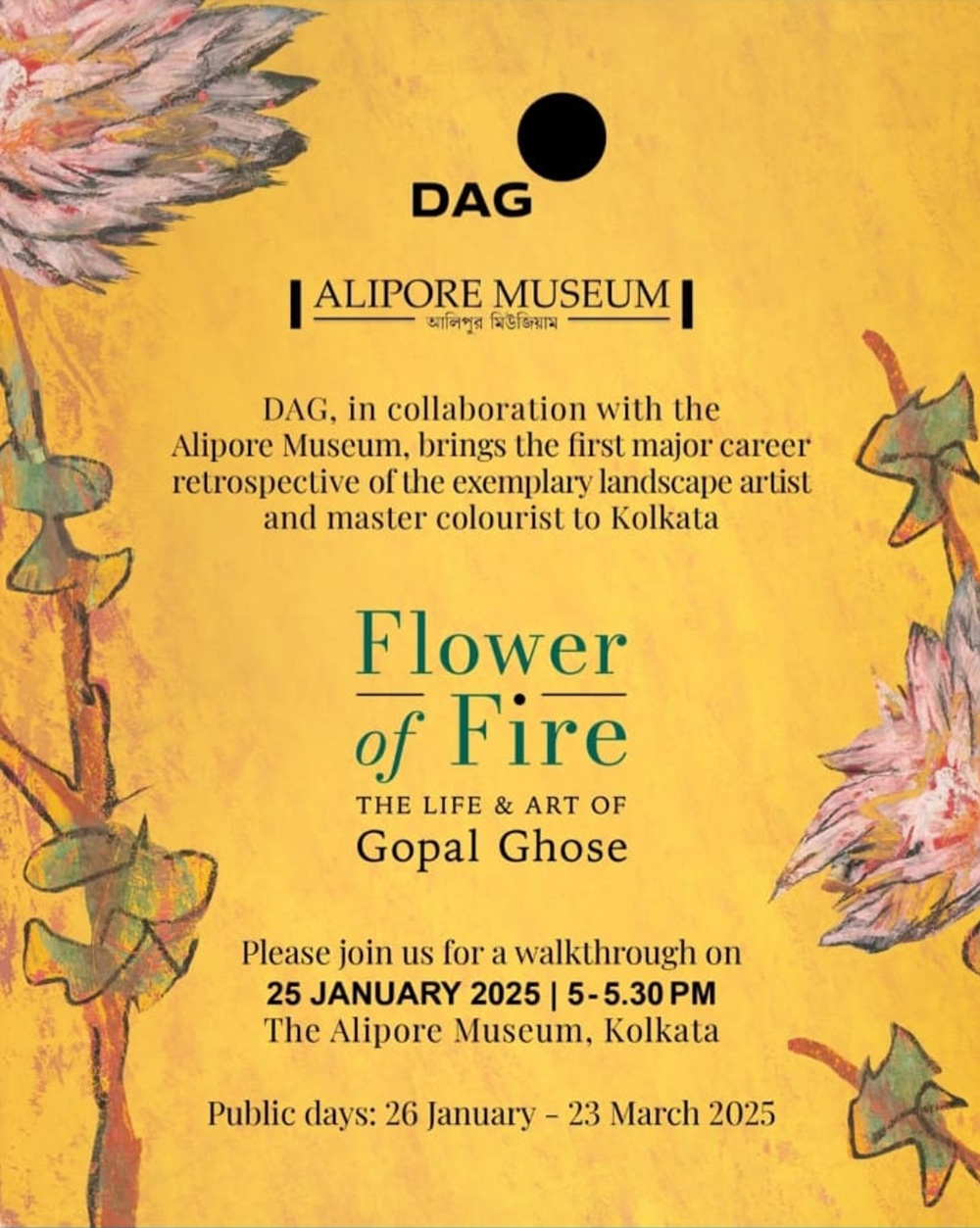
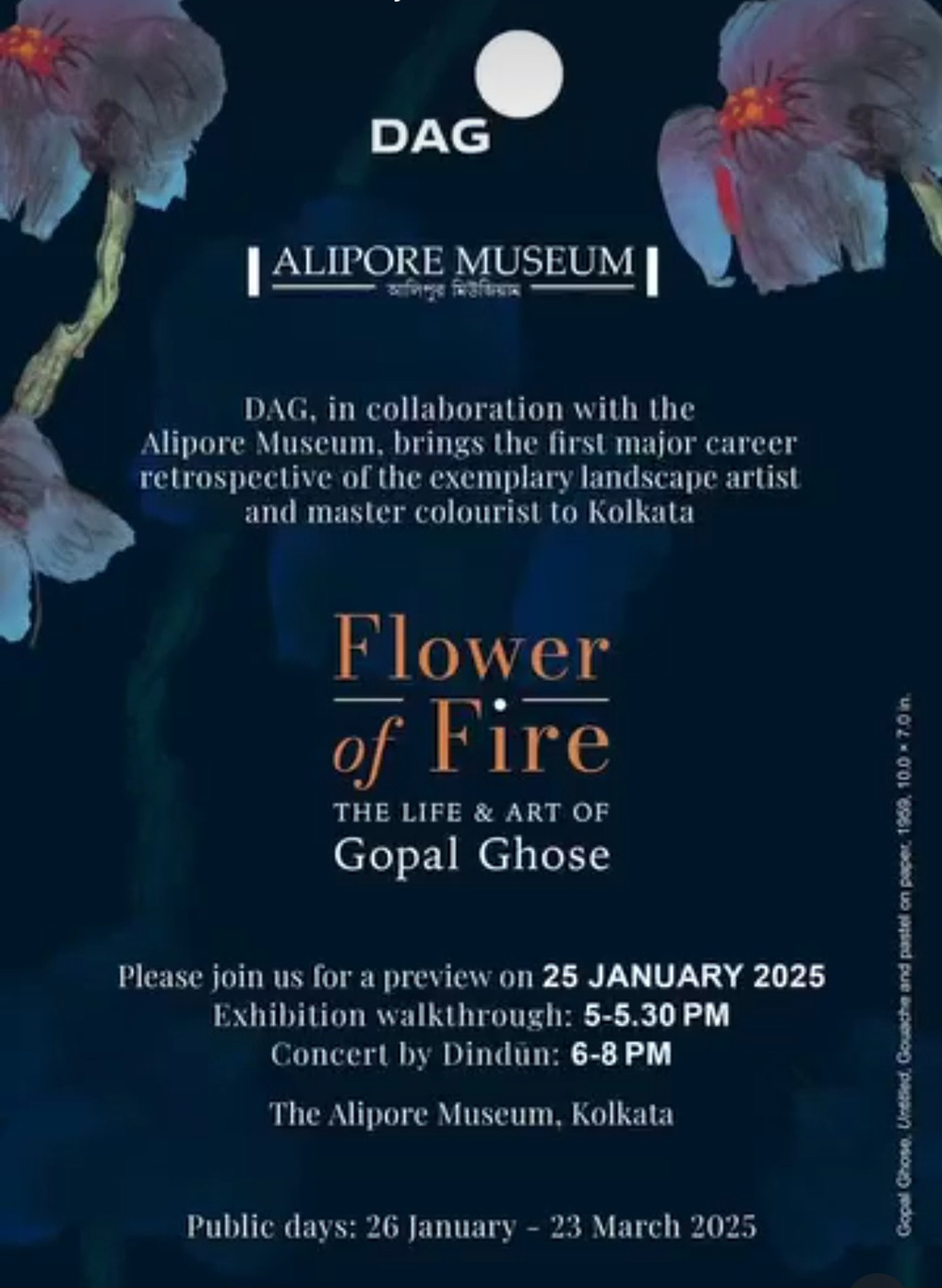
I spent some quality time in the company of Gopal Ghose this weekend: reading two books on him (one, a product of a centenary Exhibition in 2013) and attending the opening of his first retrospective in the city - which had a catalog that could be browsed through; and in addition to walkthroughs, hosted a musical performance inspired by his artworks.
It's easy to get immersed in the beauty of Ghose's landscapes -- vast or intimate, in the realms of land, water or sky... be it hill or sea, plain or forest. Flora was another abiding focus of his artistic attention. As were birds and domestic animals. There were urbanscapes, too -- a city in tumult, temple towns, architectural landmarks of a Presidency capital. And sketches galore. I'm sharing images of some artworks from the Exhibition that showcase this range of the artist.
Visiting the Exhibition soon after reading the book by Sanjoy Mallik added to my enjoyment of it. While reading books on artists, it's usually the artworks that stay with me. In this instance (primarily the centenary volume), there's also a series of images from the artist's life - drawn mainly from some reminiscences by Prodosh Dasgupta, Prasanta Daw and Purnima Sinha - that's been playing in loop in my mind: a motherless boy seeking solace in the beauty of nature in Shimla; a patriotic teenager bringing down the Union Jack and earning a bullet wound for his action; an art student exploring the environ of Madras; a young man roaming the length and breadth of his motherland on his bicycle (the folds of his dhoti billowing in the wind?); an artist sketching famine-stricken people in the streets of Calcutta; a dog-parent trying frantically to get his beloved Kallu to hospital in the midst of the carnage of August 1946; an impetuous man leaving his maternal uncle's home in a fit of rage and being sheltered by a dear friend; a popular art college teacher giving art lessons at home on Sundays - not by instruction, but by nudging his informal students to draw their own thing (on which he gave his feedback) while he himself worked quietly in their midst; an elderly artist in a troubled mental condition being taken to a hospital on the sly by his former student and her husband. Taught by stalwarts - Shailendranath Dey at the Maharaja School of Arts and Crafts, Jaipur and Devi Prasad Roy Choudhury at the Government College of Art and Craft, Madras - Ghose managed to steer a distinct course for himself from pretty early in his career. And his individuality marked him out in many ways: he sketched the horrors of the 1943 Bengal Famine, for instance, but not at the behest of a political party; he was a founder-member of 'The Calcutta Group', but later dissociated himself from it. The most telling anecdote in this regard is of him visiting Gandhi in Wardha ashram and on being asked whether he was a Bengali, replying, he was an individual!
I have been particularly struck by the range of places in British India that shaped Ghose's sensibility -- Shimla, Benarasand Allahabad in his formative years; Jaipur and Madras during the phase of his art education; and Calcutta, where he lived & practiced for the rest of his life. The Bharat-bhraman on cycle, which was endorsed by Tagore himself, was an enriching corollary to an already wide exposure to a diverse terrain.
Dumka (in present Jharkhand) would be added to that list, post-Independence, after he was introduced to William G. Archer (ICS officer, art historian and curator) and Verrier Elwin (anthropologist) by poet Bishnu Dey at an Exhibition opening in Calcutta, and they facilitated his access to the place and to the life and living of the tribals there.
Archer and Ghose would strike up an unusual friendship that would, in turn, produce a rich archive. I'm now interested in that archive and the new DAG catalog. Meanwhile, I highly recommend 'FLOWER OF FIRE: The Life and Art of Gopal Ghose' to my friends in Kolkata. It's on at the Alipore Museum till 23rd March.