

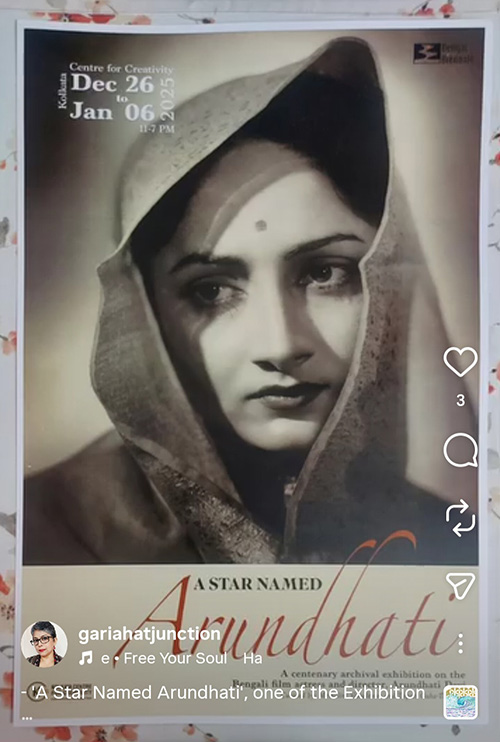
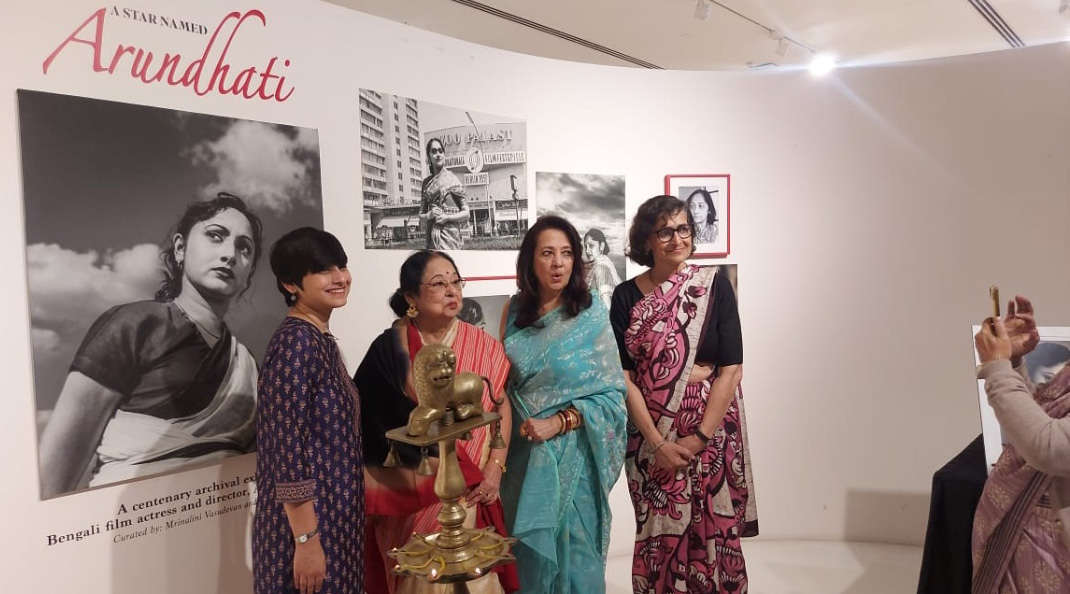
A hurried visit on the opening day of 'A Star Named Arundhuti' at KCC had left me greatly dissatisfied, as this is one Exhibition I had been looking forward to in the Bengal Biennale. Being able to attend the last walkthrough more than compensated for that!
Curators Mrinalini Vasudevan and Tapati Guha-Thakurta gave a very informative and nuanced walkthrough, alternately speaking on the eight sections of the display: A Dhaka Childhood, A Santiniketan Upbringing, Radio and Gramophone Days, Marriage and Motherhood, A Bhadramahila Actress, Life with Tapan Sinha, Forays into Direction and Production, and Lost and Unfinished Legacies.
The curators happen to be a niece and a grand-niece of Arundhati Devi. This mix of generations – one who has a treasure trove of memories of her 'chhoto-pishima' right from her own childhood till her aunt's death and knows anecdotes galore of her; and another, who had met her when she was a one-year-old and has no personal memory – gives an interesting double perspective even from a family angle. Their individual interests as scholars also add different dimensions to the show: with the mother having an abiding interest in archiving in general and family photographs in particular (she has curated two photographic Exhibitions before); and the daughter coming to the project primarily from an interest in film history.
The bulk of the Exhibition is sourced from the 'star's family archive – meticulously maintained and generously shared by her children. Besides photographs, it includes audio recordings, video clips, movie-stills, posters, booklets and memorabilia.
The photographs steal the show, of course. But the most striking take-away from it is not the images, but the fact that print can outlast celluloid. A lot of Arundhati's films are lost and information about them could be retrieved, we got to know, only from booklets on the films, many of which were displayed in the show.
Though Arundhati was a very successful actress of her generation, she began her artistic career as a Rabindrasangeet singer on A.I.R. Having trained under Indira Debi in Santiniketan, this wasn't an unusual choice. Her love of music and literature, imbibed in Santiniketan, would, in fact, later shape her aesthetics as a filmmaker. Her educational background also marked her out among several other leading ladies of the time, and probably helped her in bringing to bear a certain confidence and elegance even while essaying conventional roles in mainstream Bengali cinema.
My favourite films of hers as an actress are all from a time when she had already established herself in the industry and where she is paired with Uttam Kumar. 'Jatugriha' tops that list, followed by 'Bicharak', with 'Kshudito Pashan' and 'Jhinder Bondi' coming a close third. I had seen all these films on DD Bangla in the 80s, but it is while re-visiting them while writing on 'Jatugriha' some years back that I developed a new admiration for her. As also her paring with Uttam. I, in fact, like her opposite Uttam more than Suchitra (blasphemous though it is to say so). I was thus delighted to find a separate section on them in the show.
I didn't know much of her personal life before. From what I could glean from the Exhibition texts and walkthrough left me with even greater admiration for the individual Arundhati – the woman who pursued her passion and came into her own while bringing up two children (14 years apart) and negotiating difficult personal equations born of two marriages (to Prabhat Mukhopadhyay and Tapan Sinha).
She had a wonderful creative partnership with Tapan Sinha, but the flip side of it was that her films were often thought to be directed by him! Also given the times, there wasn't any formal acknowledgement of assistance given by a partner in different departments of filmmaking – including script, costume and set design. There wasn’t much conversation either around the legacies of female directors and producers who came before her – like Manju Dey and Kanan Devi.
There were two small photographs (in different sections of the display) that caught my attention. In one, a young Arundhati is seen at an event with Kanan Devi, Anubha Gupta and others. In another, a middle-aged Arundhati is shown sharing a light moment on a set with Subhendu Chatterjee and Aparna Sen. There's a documentary on Sen ('Parama') by Suman Ghosh that's just had a theatrical release in Kolkata. I wish someone would join the dots between those two photos and the documentary.