

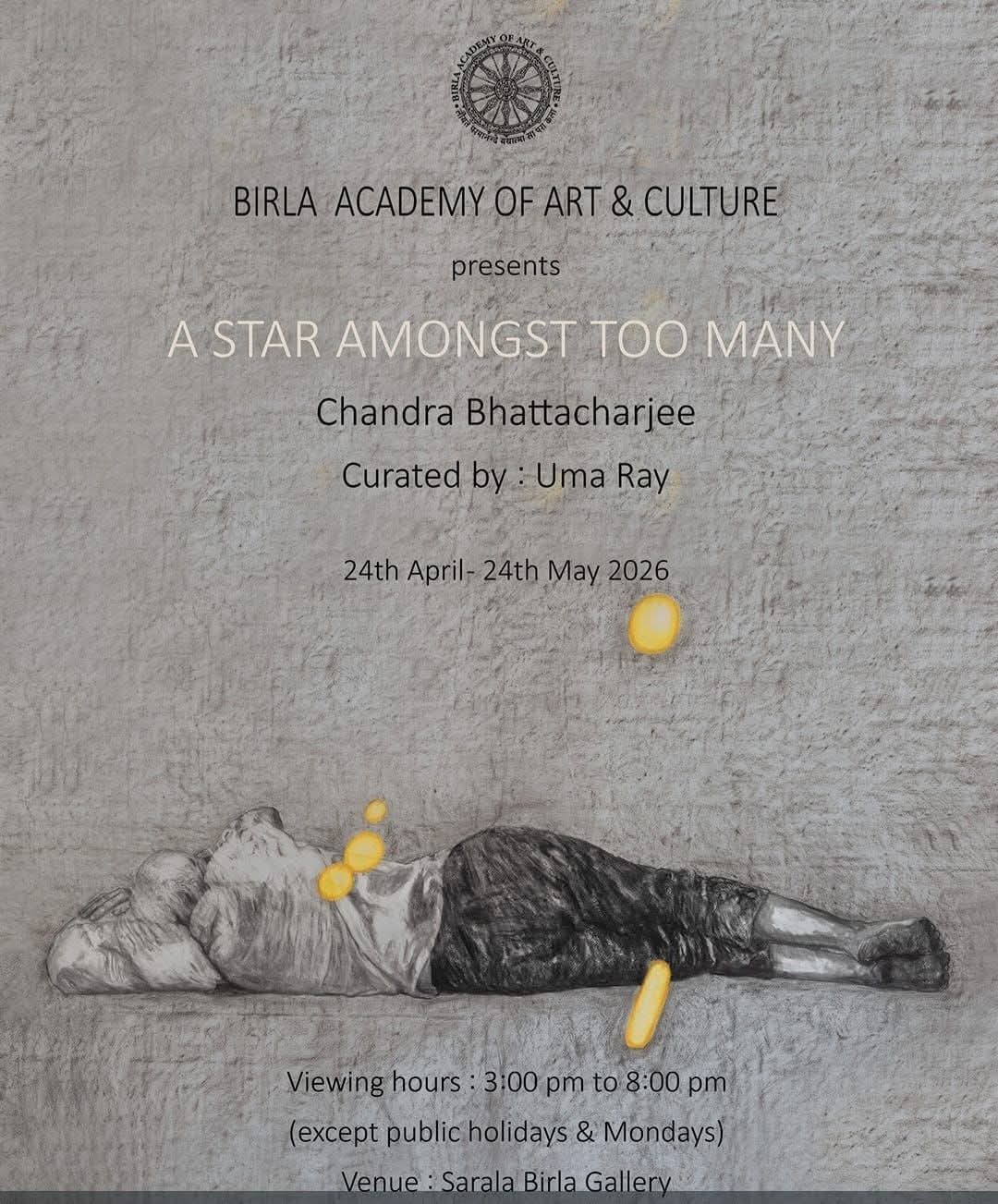
They are everywhere in a metropolis. At stations and bus depots, on main roads and footpaths, in street corners and alleyways. They are everywhere, but we don't see them. Or rather, we see through them. Shabby, stinky, with nothing much of their own and nowhere to go, these marginalized and invisibilized men and women are habitually erased out of the race of a perpetually upwardly mobile society that has no space for them. They are its anonymous dregs – without any name, identity, or distinguishing feature that can mark them out from others.
In a rare solo curated by Uma Ray - 'A Star Amongst Too Many' - artist Chandra Bhattacharjee has decided to turn their anonymity and invisibility on its head. Blowing them up to gigantic proportions - so that we have no choice but to take heed of their presence - is his way of artistic atonement, of apologizing on society's behalf, of offering moral recompense.
He keeps them anonymous. But makes them distinct. Each separate from the other. There are 23 portraits hanging from 10 walls of varying dimensions in the Sarala Birla Gallery of the Birla Academy of Art and Culture, Kolkata. The majority of the figures have their back on us, most of them walking away – as if the artist has captured them just before they vanished altogether. But there is no way of knowing their exact location or where they are headed. The background is deliberately empty or blurred. In several, we don't even get to see their faces. The artist simply intends to imprint their presence on our consciousness.
The portraits are all 5 feet by 8/8.5 feet, executed on paper and drawn with charcoal pencil. Art imitates life here: the most basic of artistic tools conveying the rudimentary nature of the subjects’ existence. The subjects’ themselves (with few exceptions) range from the ageing to the elderly, in all possible postures – walking, standing, sitting, sleeping – thus effecting a balance between motion and repose in the exhibited space. They are also, all, solitary figures, living out their precarious lives bereft (it seems) of company or community. Here is an old man sitting on a step with his head bent, palms folded on his lap, feet spread outwards in a V, a stick and a bag beside him; there is a woman walking bare feet with a bag, facing us on her left, hair tied up in a neat bun, with a bangle and an arm band gracing her hand; and in a triptych (of sorts) of sleeping figures in the brightest room painted lemon yellow, there is a figure completely wrapped in a striped cloth, shrouded in mystery. The old man is the very picture of stoic waiting (for death?), the aged woman exudes a quiet dignity; both are lost in thought. Most of the figures, in fact, have this contemplative quality about them: they seem to be weighing in - with a profound sense of desolation - their place in the scheme of things, even as they go about their utterly forgetful existence.
The overwhelming greyscale palette of the show notwithstanding, there are some coloured spots in the drawings, using dry pastel. They signify different things in different portraits. The yellow in some represent hope. The rust in others is meant to denote exactly that – rusted lives, wasting away in neglect. A suite of smaller works is also in colour – actually, charcoal drawings overlaid with dry pastels, which are taken up with the humble belongings of the poor: cooking utensils, containers and boxes, mats and quilts. They speak of uncertain lives always on the move.
The people who feature in A Star Amongst Too Many are those the artist has observed in different parts of Calcutta/Kolkata over several decades – in Sealdah, Kalighat, and Southern Avenue, among others. Sealdah, especially, from the time he painted hoardings to make ends meet as a student. He is no stranger to drawing huge figures. But they were, then, of people and commodities that needed to be advertised. From his perch on wobbly bamboo scaffoldings, he would see a diminutive mass of creatures of a lesser god, who remained invisible even on level ground when they assumed normal human proportions. Through all the changes of his address and his changing fortune, these people remained exactly where they were. Changing regimes didn’t change their fate. The city kept morphing into new avatars, but they looked just the same.
Drawing is to an artist what description is to a writer. The most basic and essential quality required to practice in that form. An artist may choose not to specialize in it, but he/she cannot function without a felicity in it. Drawings are usually made as preparatory work for larger paintings, prints or sculpture. They also often function as journals or shorthand notations for bigger ideas. But in this solo, Bhattacharjee has accorded this most essential tool/quality in creating fine art a greater dignity. And elevated the genre by mounting an entire solo based on it.
One wonders, though, whether his visitors include the kind of people he has put up on the wall.