

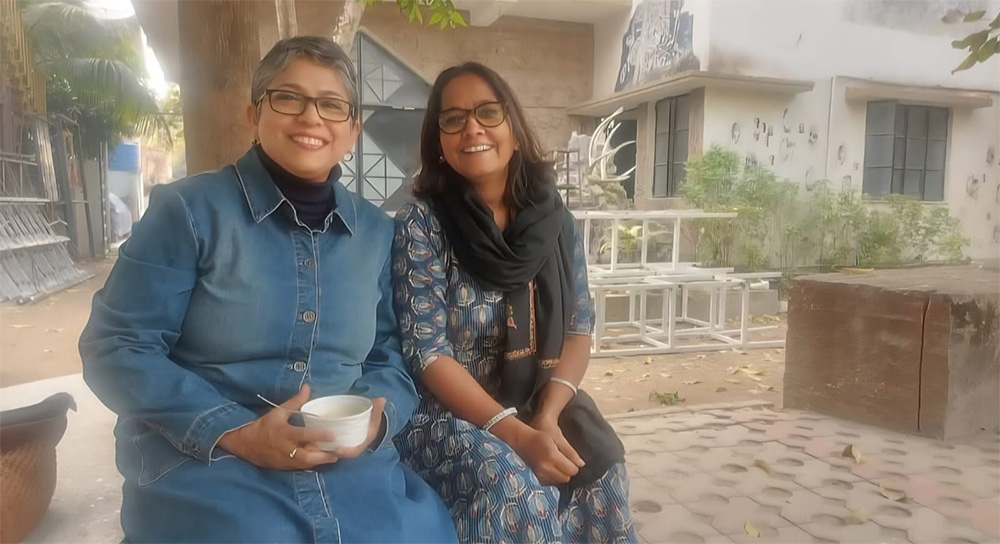
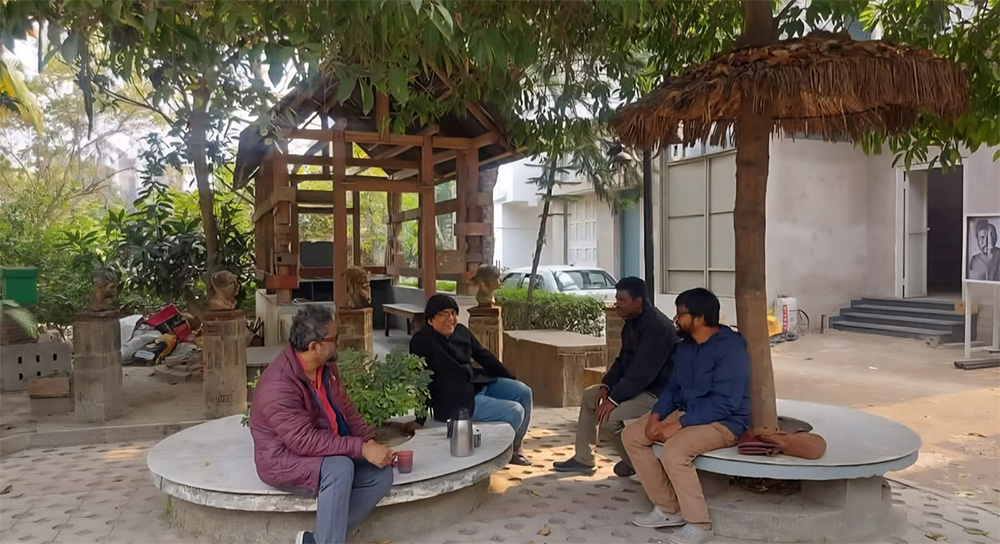
The invitation was long-standing; the intention, longer still. It finally happened on a quiet winter morning -- my first visit to 'Chander Haat'. Operating out of a beautiful space in Sarsuna, it's an art collective that believes in and encourages interdisciplinary and community-based art practice. Founded in 2008, its members include Tarun Dey, Bhabatosh Sutar, Mallika Das Sutar, Pradip Das, Pintu Sikdar, Nirmal Malick and Anjan Das. I could meet only the artist-couple in this collective during my visit earlier this week, apart from Pradip (who showed me around), and got introduced to one of their friends (Sujay Das).
Each of the members have their individual art practice, but it's their collaborative work that binds them in this space. The Sutars and Tarun Dey also have their homes here, that form a continuum with the shed under which they hold their programs and the studio spaces that half-encircle the remaining plot of land. The newest building there is Pradip's upcoming studio, which should be ready soon. He was busy instructing labourers and making calls in between our conversations.
It's his art practice that I'm principally familiar with and have engaged for some time now, after being introduced to him by Tapati di. Some talk about his recent/current shows was thus inevitable -- his solo at the Kolkata edition of the Bengal Biennale at Arts Acre; the two-day Exhibition, 'Abohoman', at the India Story, Swabhumi, that had just happened the weekend before; 'Dialogues Across Time', at the Indian Museum, curated by Sayantan Maitra Boka, where the collective is now showing; his present interest in the Sunderbans; and ideas of working on Marichjhapi. As a visual corroboration of that interest, a giant replica of the cover of 'Bon Bibi Johura Nama' can be seen in one corner of his new studio. There's an air of mute anticipation in the empty rooms of this space in-the-making. I loved the stairs to the balcony, with a coconut tree standing sentinel over it, its branches providing a natural shade on the mezzanine. The windows on the upper floor look out on more green, while allowing ample winter light in.
The main common studio of the collective, spread across two floors, includes a conference room and also has accommodation for artists who come here for residency. The open kitchen and dining hall adjacent to those rooms are inviting, and look ideal for adda and joyous congregation. Indeed, there was a feast the previous night that some 30 people partook of, I was told, with Pradip as cook.
"We don't just work... we also have a lot of fun", Bhabatosh said, as I was leaving, while extending his invitation to come again. But I needed no such enticement. The routine rhythms of an everyday interests me -- be it in the life of an individual, a family or an institution or collective.
I went on the quietest of days, as it happens, with the heat of activity missing. There was also no artwork or installation on view, contrary to my expectation (I had somehow imagined huge jute installations to greet me on arrival, remembering some striking visuals from their project 'Language of Space' archived in their website); with the result that what I encountered was mostly a 'cleared-up' space awaiting new creations. This apparent lull, however, masked the collective's most recent triumph -- being awarded the Vivan Sundaram Grant for Installation Art 2024, by the Sher-Gil Sundaram Arts Foundation (SSAF), for their on-going site-specific installation art project, 'Jadu Ghar: Floating Stories'. It is organically connected with and involves the lives of migrant families from Sunderbans, Bihar and Bangladesh who eke out a precarious existence on the banks of the Kalagachi canal of Khudiram Pally, Sarsuna.
They told me of their last-minute application for the grant, with some delight, and the time by which they need to finish the project. Many other anecdotes were also shared. In the roughly four hours that I spent there between breakfast and lunch, I heard stories spanning 30 years: of how Bhabatosh's teacher, Tarun Dey, "discovered" him; the early years of their association in the 90s; his struggles as a young artist and the part played by his wife Mallika in that journey (which included a short and rather shy recounting of how they met and became close, upon my asking); the earlier avatar of 'Chander Haat' - 'Sarsuna Environmental Art' - and its heydeys; the remarkably short time within which the collective established itself as an alternative art space in Kolkata; its popular annual winter event in its earlier phase; the many collaborations they entered into, including one with the Gurusaday Museum ('Archiving voices and expressions'); the very difficult pandemic years when they couldn't work together; and the way they have stood by each other in times of personal crises.
In between talking, I spent some time leafing through a unique bi-lingual publication - 2 Volumes of 'Mathe Ghate Shilpa: Art on Ground 0' - each, an anthology of essays (in Bangla and English) and images compiled and edited by Bhabatosh Sutar, connected with his Durga Puja installation work at the Arjunpur Amra Sabai Club in two consecutive years. The first volume is particularly arresting, with a long reflective essay by Sutar, printed just as the diary pages he wrote in, running uninterrupted on the left side of the volume, with contributions by others on the right, corresponding with the themes and topics he touches upon in his piece. It's a labour of love that found few readers, as I gathered from Sanjoy, who worked on these volumes closely with his friend.
Bhabatosh's is very well-known for the public art he has created for Durga Puja for over 25 years. His passion for it remains unabated, as is his gift to connect with his audience year after year. His work 'বারিবিন্দু: the raindrop' for instance, at the Salt Lake AK Block Association, was a major crowd-puller last Pujo, with a video of the installation going viral on social media. I asked him about this year's Pujo... but, of course, it was too early to discuss that.
Most of the free-flowing conversation I had with the collective that day happened under a tree, in the central open ground of the location, with different members joining in and leaving at different points -- Mallika, earliest in the morning; followed briefly by Bhabatosh's brother, and Pintu Sikdar; then, for quite some time, Sujay; and finally, Bhabatosh; with Pradip remaining the sutradhar throughout.
Mallika is the only member of the collective with a day job, as Art teacher in a neighbouring girl's school (where she additionally teaches Life Science from grades V to IX, owing to the paucity of staff). Before she rode away on a bike to work, she spent time with me, graciously offering me 'Nabanna' with the morning tea -- something I've never had before. Made of freshly ground coconut and rice flour, with a hint of ginger and cumin, it's meant to be had mixed with khoi (a variant of parched rice with which many deserts are made). It's delicious; I kept on adding khoi (a favourite staple of mine), and ended up having two bowls! That was not all. Mid-way into my visit, a plate of 'pithe' came, in two varieties. I'm not a big fan of pithe, but it couldn't be avoided on the day of Poush Sankranti; and I wanted to honour the mother who kept feeding us, whose absent presence was conveyed to me through the food.
In the past year-and-a-half, I've visited the studios of several artists, usually driven by a specific agenda -- of either writing something with the aim of immediate publication, or to gather resource for an ongoing personal project of mine. The visit to Chander Haat was very different -- it was primarily to witness a way of life and work and art practice that I know little of.
The most beautiful moment came, unobtrusively, just before I left. From a nearby mosque, there emanated the mid-day azan - not in the ear-splitting decibels of a loudspeaker, but the sonorous tones of a pious voice praying - immediately hushing us into a spontaneous silence. The afternoon went to repose in the stillness of that moment.